Paul O'Brian writes about Watchmen, trivia, albums, interactive fiction, and more.

>SUPERVERBOSE

Category: Uncategorized Page 5 of 31

Album Assignments: Highway 61 Revisited

So here’s the thing with Highway 61 Revisited. It’s hard to find anything new to say about this album. Entire books have been written on the topic, and I’ve even read some of them. I also wrote extensively about “Desolation Row” since it was quoted in Watchmen. Not to mention the three different posts I’ve already written about Bob Dylan in this Album Assignments series. I don’t have a whole lot more to say about him.

So I’m taking a different approach with this post, a more personal approach. I write a lot about how music feels to me, and I often try to capture with words how a particular song or moment works, but while I will sometimes introduce that stuff with a little bit about my life, I tend to write about music a lot and life very little. But music is woven into my life, and among other things serves me as touchstones, allowing me to time travel back to specific moments that emblematize greater relationships or themes.

Take “Like A Rolling Stone”. Obviously it’s a rock classic, and a huge milestone in Dylan’s career, and your local library is full of explanations about that. But I listen to the first two lines of it, and more often than not, I have Bob Herd in my head. That story you won’t find in the library.

Album cover of Highway 61 Revisited

Robby and I cemented our friendship when I was about 15 years old. We spent a lot of time at each other’s houses in high school, and during summers and breaks in our college years. So that meant we got to spend a lot of time with each other’s parents. Robby’s dad Bob was a kindly giant to me, a big tall goofball with Texas roots who would always try to crack us up as he made his way through the house. He was always especially good to me — in fact one time we even hung out together without Robby around, as we both really wanted to see Tim Burton’s 1989 Batman movie and Robby had zero interest.

Bob loved classic rock in general, but specifically he was a huge Dylan fan. Robby tells me how on Sundays, his dad would sit down with him and play through some favorite record, pointing out great bits and telling stories as they’d listen. That’s where Robby’s appreciation of Dylan came from, or at least where it started. Bob and I would talk Dylan sometimes too, taking turns rhapsodizing about the musicians and especially the lyrics.

I have an image of Bob in my head. He’s coming down the stairs in Robby’s old house, while Robby and I are hanging out in the living room. His steps are heavy, and once he’s sure he has our attention, he drawls out: “Once upon a time you dressed so fine! Threw the bums a dime, in your prime!” A call, waiting for a response. We wouldn’t let him down, giving it our best nasal Dylan as we belted, “Didn’t youuuuuu!” We all three laughed at each other’s silliness, having a blast.

Bob passed away in 2007, much too young. When I hear “Like A Rolling Stone” now, I feel like he’s with me, just for a few moments, right at the same time as I wish that I could see him again.

There’s another touchstone for me at the beginning of the song “Highway 61 Revisited.” Dylan blows this wacky siren whistle a couple of times in the first five seconds of that song, a wild and silly sound that immediately sets the song apart from any other rock and roll tune before or since. Plenty of ink has been spilled about that creative choice, but none of it is about my friend Tashi.

Tashi and I worked together for many years at the University of Colorado, first for the central IT office that serves all the campuses, and then for the Boulder campus IT group. At various times I was his peer, his manager, and his colleague. He’s one of my favorite co-workers ever, and pretty much one of my favorite people in the world. Like me, he loves comedy and music, and he especially appreciates when they come together.

Tashi and I shared an office for a long time, which was the source of many a delightful conversation, sometimes trying to make each other think but usually trying to make each other laugh. At one point I was working and I suddenly heard, out of nowhere, those few notes of organ and — wOOOOOOooooo! — that siren whistle. Then it almost immediately stopped. I looked up, and the sound repeated. It was then I realized that Tashi had made that his ringtone. Hilarious.

Health issues eventually forced Tashi out of his job at CU, but we’re still friends. He comes over pretty regularly to help tutor Dante in math, not because math is a huge struggle for Dante but because Tashi absolutely loves it and gets immense pleasure from helping teach it. Much to Dante’s delight, Tashi always sticks around after the math work to play a board game or computer game or something. Our whole family loves having him around, because not only is he a wonderful mentor to Dante, he’s also super fun and incredibly funny. That siren whistle pretty much nails how I feel about him. wOOOOOOooooo!

I’ve got lots more memories attached to this stuff. Robby and I were counselors in the early 90s at a college-style camp for gifted middle and high school kids – they stayed in dorms at night, took awesome classes during the day, and participated in counselor-led activities in the afternoons and evenings. Some of the time was just “dorm time”, where the kids could hang out, play cards, and whatnot, while counselors stationed themselves at some central location. I remember clearly my little boombox in the center of a first floor dorm hallway, blasting out this album and some others (Freewheelin’, Another Side) to a small cadre of fascinated kids, getting intiated into the mysteries that had captured generations prior to theirs.

More recently, I had the pleasure of seeing Bryan Ferry in concert, and he played a cover of “Just Like Tom Thumb’s Blues” that gave me major goosebumps. And now that moment is with me too, even as I dig Dylan’s very different version. Like Pretenders II, this is an album I just never get tired of. I could listen to it over and over, and sometimes I do, because it brings back such happiness to me, and more great memories await.

The Watchmen Bestiary 28 – Mutiny, I Promise You

Ahoy there! Spoilers dead ahead, both for Watchmen and for the many versions of Mutiny On The Bounty. You’ve been warned.

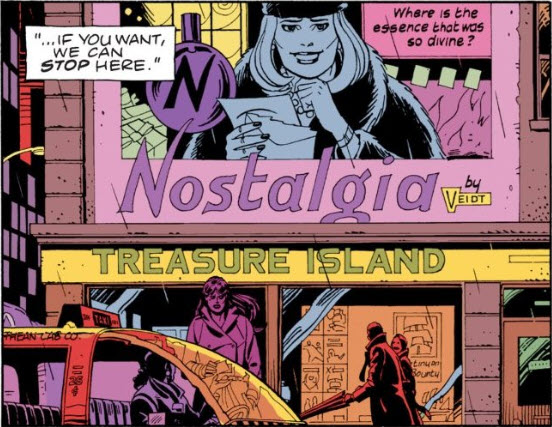
I’ve got mutiny on my mind today because of this panel:

A panel from Watchmen Chapter 3, page 7, in which Laurie gets into a cab in front of the Treasure Island comic shop, which displays a Mutiny On The Bounty poster in its window.

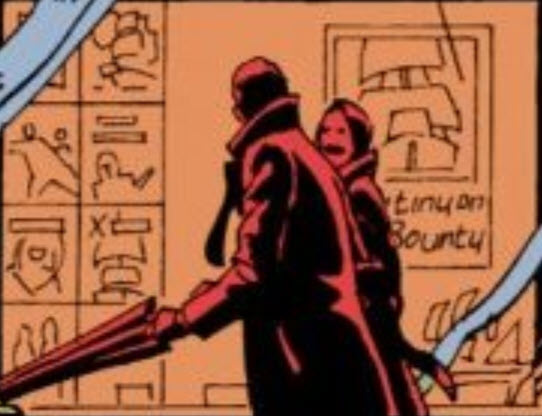
Actually, let’s zoom in on the bottom right corner of that panel:

A detail from the panel, which shows the Mutiny On The Bounty poster clearly

The web annotations zoomed in on this spot as well, pointing out:

Also, note the comic “Mutiny on the Bounty” in the comic shop’s window, and the prevalence of pirate themes in the covers of the other comics. One comic has an “X” in its title, perhaps a sly reference to the “X-Men” comics of the real world. (The title “X-Ships” appears on a comic early in Issue 1.)

As much as I love to chase down every little reference, I won’t be writing a post on the X-Men and Watchmen — the connection is just too slight. The annotators are probably correct that “X-Ships” references X-Men, given that X-Men comics were at their peak of popularity when Watchmen was being written. Since pirate comics dominate the Watchmen world, X-Ships are their likely X-Men analog, but that strikes me as just a little joke, not the kind of intertextual allusion that this series digs into.

Mutiny On The Bounty is another matter. I would argue that this reference illuminates several levels of Watchmen. But before exploring that, let’s talk for a while about the story itself.

Making a Mutiny

One might ask first why Mutiny On The Bounty would be a pirate comic at all. Sure, it’s a nautical tale, but it’s hardly Treasure Island. Where are the pirates?

Well, it turns out that most versions of the story refer to the mutineers as pirates. They may not be one-legged parrot-keepers plundering merchant ships for doubloons, but they do in fact take the ship they had crewed, and anyone who seizes one of His Majesty’s ships becomes a pirate in the eyes of the British Navy.

The historical facts of the mutiny are as follows. The cutter Bounty was commissioned to collect breadfruit plants from Tahiti and bring them to the West Indies, in hopes that the tree could be cultivated as a food source for plantation slaves on those islands. Lieutenant William Bligh commanded the ship, which had been specially fitted out to hold six hundred plants. This remodeling shrank the living space of everyone on board, making an already uncomfortable sea voyage even more difficult.

Bligh’s original plan was to travel west from England to Tahiti, rounding Cape Horn on the way to Oceania. However, bureaucratically-imposed delays meant that the Bounty didn’t start sailing until the weather had turned impassable south of the Cape. Bligh, a disciple and former navigator to the revered Captain Cook, was an immensely confident sailor, but this circumstance thwarted him. He tried for nearly a month to get through, but eventually gave up and headed east, stopping to re-provision the ship at Cape Town, then sailing onward, south of Australia (called New Holland at the time) and New Zealand to Tahiti, where he landed in late October of 1788.

By all accounts, Tahiti was a sailor’s paradise. It had gorgeous weather, stunning landscapes, abundant food and water, and friendly indigenous people, with a far less sexually inhibited culture than that of 18th century England. The Bounty‘s botanical mission obliged its crew to stay on the island for several months, so that they could secure agreements with various native chiefs to take plants from their groves. In the process, many members of the crew also formed relationships with native women. The initial delay in launching the ship also meant that it must wait out the western monsoon season, which wouldn’t end until April. Thus began a five-month tropical sojourn for the ship and its crew.

A painting of the Bounty in front of a Tahitian landscape

On April 5, 1789, laden with over 900 breadfruit plants (Bligh had somehow made room on the ship to store even more than planned), the Bounty set sail from Tahiti. Their orders were to pass through the Endeavour Straits (now known as the Torres Strait) between Australia and New Guinea, in hopes that Bligh’s navigation and surveying skills could help define a safe passage for future missions. But the Bounty would never travel through those Straits.

At dawn on April 28, master’s mate Fletcher Christian and several accomplices awakened Bligh. They dragged him, clad only in a nightshirt, up on deck. The mutineers ordered Bligh into the Bounty‘s launch, where he was joined by seventeen loyalists. Several others remained on board the Bounty, either detained by the mutineers for their skills, or simply unable to fit into the already dangerously overburdened launch.

Bligh and his crew traveled over 3,600 miles in an open boat, from the site of the mutiny to the island of Timor. They endured extraordinary hardships of starvation and exposure, and they did in fact pass through the Endeavour Straits. Bligh’s entire crew survived this journey, with the exception of quartermaster John Norton, who was killed by hostile indigenes on an island where the crew had attempted to re-provision. After reaching the Dutch settlement on Timor, Bligh and company found their way back to England, where his journey was rightly hailed as an astonishing act of seamanship.

Meanwhile, the mutineers and remaining loyalists splintered. Some stayed on Tahiti, taking wives and having children. These men were collected several years later by the British vessel Pandora, which itself then sank in the Endeavour Straits. The survivors of that shipwreck took the remaining prisoners back to England, where they were court-martialed. Some were acquitted, some were found guilty but pardoned by the crown, and some were hung. The rest of the mutineers had fled to the remote Pitcairn’s Island. The British never caught these men, but they fell out among themselves and the Tahitians they had brought along, such that there was only one Bounty crew member remaining when an American vessel stumbled upon the island twenty years later. The descendants of these mutineers and Tahitians live on the island to this day.

What doomed the Bounty? What brought Fletcher Christian and his fellow crewmen to such an emotional extreme that they were willing to become pirates and set eighteen men adrift to what must have seemed like certain death? What does this mutiny mean? The answers to these questions have been much disputed, and their portrayals over the years are a saga unto themselves.

Story vs. Story

Bligh returned to England in March of 1790. He was court-martialed — mandatory for any captain who lost his vessel — and exonerated of all charges. Within a few months, he published his Narrative of the Mutiny, which in fact devoted a scant six pages to the mutiny itself, and another eighty to his open-boat journey. He declined to speculate on Christian’s motivation, saying only that he heard the crew cheering “Huzza for Otaheite” (“Hooray for Tahiti”) as the launch pulled away. (The Bounty Mutiny, pg. 10) Based on this narrative, England hailed him as a hero. He met the king, was promoted twice, and subsequently set sail on another breadfruit expedition, departing in August 1791 aboard a ship called the Providence.

Meanwhile, the Pandora had launched to capture as many mutineers as it could find, and its survivors returned to England in March of 1792. The prisoners’ court-martial that summer resulted in three hangings, four acquittals, and two royal pardons.

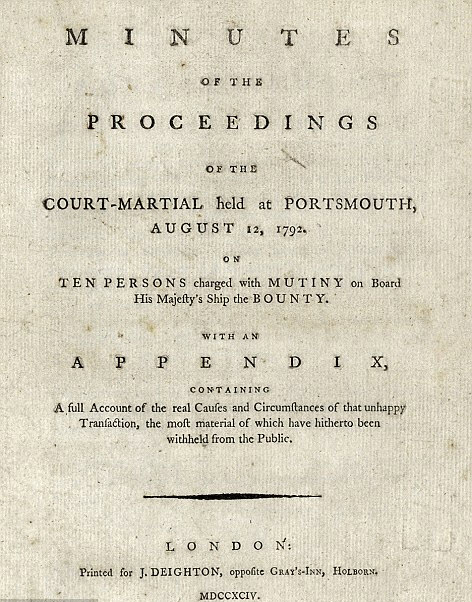
After the dust settled, the first competing narrative began to take shape. Fletcher Christian’s brother Edward, a Cambridge-educated lawyer, took it upon himself to interview all returned survivors of the mutiny, both those who had journeyed with Bligh and those who had been captured by the Pandora. He released a pamphlet with a partial transcription of the court-martial, and an extensive appendix (The Bounty Mutiny, pg. 67), which used those interviews to condemn Bligh as a tyrant and show Fletcher Christian as a noble soul who rebelled only as a last resort under intolerable circumstances.

The front page from Edward Christian's version of the story. It reads "Minutes of the Proceedings of the Court-Martial held at Portsmouth, August 12, 1792, on Ten Persons charged with Mutiny on Board his Majesty's Ship the Bounty, with an Appendix containing a full account of the real causes and circumstances of that unhappy transaction, the most material of which have hitherto been withheld from the Public."

That argument saw print in 1794, in the midst of a historical moment ripe for such a story. The French Revolution had overthrown the monarchy there just a few years prior, and the American colonies had rebelled less than fifteen years before that. Individuals longing for freedom and deposing tyrannical authorities were the cultural order of the day, and Romantic poets such as Wordsworth and Coleridge found an avatar in Fletcher Christian. In addition, the Jacobins of the French Revolution exalted the philosophies of Jean-Jacques Rousseau, whose notions of mankind’s goodness in a “State Of Nature” were easy to overlay upon the Tahitian indigenes, thus providing another justification for men who wanted to leave a corrupt civilization and live amongst “noble savages.”

Bligh returned in 1794 and exchanged retorts with Edward Christian, but the sailor was ineffective against the lawyer, and the damage to Bligh’s reputation would never be fully undone. The discovery of survivors on Pitcairn’s Island in 1808 excited public interest again, and launched a new wave of Bountyphilia. Sir John Barrow published an account in 1831 which upheld the image of Bligh as an overbearing martinet. Barrow was a family friend of Peter Heywood, one of those captured by the Pandora and later pardoned by the crown. In 1870, Heywood’s stepdaughter Lady Diana Belcher published another version of the story, again justifying Heywood and Christian against a Bligh portrayed as ever more villainous.

There were theatrical plays made of the story, but it didn’t receive the full novelistic treatment until the twentieth century, when Charles Nordhoff and James Norman Hall published Mutiny On The Bounty in 1932. For dramatic purposes, they created the fictional viewpoint character Roger Byam, who stood in for Heywood on the Bounty‘s crew. Nordhoff and Hall grounded their story in many historical facts, but also invented details to corroborate Bligh’s cruelty and Christian’s nobility. There was in fact a full Nordhoff and Hall Bounty trilogy — book two followed Bligh’s voyage and book three the life of the mutineers on Pitcairn’s Island — but it was Mutiny On The Bounty that caught the public’s imagination most. Hollywood took notice.

Mutiny On The Big Screen

MGM released its film Mutiny On The Bounty in 1935, directed by Frank Lloyd and starring Clark Gable as Fletcher Christian, Charles Laughton as William Bligh, and Franchot Tone as Roger Byam. MGM’s movie directly adapted Nordhoff and Hall’s novel, and it was a smash success, capturing the 1935 Academy Award for Best Picture. Gable, Laughton, and Tone were all nominated for Best Actor, splitting the vote and leading to the creation the next year of the “supporting role” Oscars.

The Lloyd Mutiny film amplified every exaggeration of Nordhoff and Hall’s, and layered in quite a few new ones. For instance, in the novel Byam witnesses another captain order a man flogged, and the punishment kills its target. The captain then orders that the flogging continue until the full complement of lashes have been delivered to the bloody corpse. (This scene has no basis that I can find in the surviving historical evidence surrounding the Bounty.) In the movie, it is Bligh who gives that order, and stands watching with satisfaction until the grisly punishment is complete. In historical fact, Bligh had a fastidious aversion to flogging, and tried to avoid it as much as possible.

Similarly, where Bligh’s actual log records his disgust with his surgeon Thomas Huggan, who he saw as a “Drunken Sot” (The Bounty, pg 84), Nordhoff and Hall give the surgeon a wooden leg (nodding to Stevenson, I suppose) and an ever-present bottle of brandy. Lloyd’s film has everyone on board calling the surgeon “Old Bacchus”, introduces him by hauling him aboard in a net, and turns Dudley Digges loose on him with a ridiculously broad performance.

Then there are the scenes entirely invented for the film. Laughton’s Bligh keelhauls a man, which happened in neither the book nor the historical record — the practice had been outlawed in the British Navy for decades. Gable’s Christian turns to mutiny after some crew members are unjustly imprisoned, but in the book, he simply bristles at being unfairly accused of theft. Finally, Lloyd’s film shows Bligh himself in command of the Pandora, unlike the book which correctly depicts its captain as Edward Edwards. Aside from these story changes, the simple act of casting Gable as Christian and Laughton as Bligh tells the audience very clearly where its sympathies should lie. Laughton in particular turns in a marvelous performance as a corrupt, blustering villain.

A still from the preview of the 1935 film, showing Charles Laughton as Captain Bligh

All these changes are made for the sake of drama, and they work very well, but their dramatic logic is simple indeed. Every uncertainty and nuance of the historical record, already greatly flattened by Nordhoff and Hall, gets sanded down into a stark story of good versus evil, of corruption overthrown by force. Just as Hollis Mason observed about Superman’s relation to the pulps that preceded it, Lloyd’s film (released three years before the debut of Superman) similarly removes the last of its predecessors’ darkness and ambiguity in favor of a basic, boiled-down morality.

Interestingly, after 1935 the pendulum began to swing back in the other direction. In 1962, Carol Reed and Lewis Milestone directed a version of the story starring Marlon Brando as Christian and Trevor Howard as Bligh. When Gable clashed with Laughton, you knew who to root for, but in the 1962 version, no character is particularly sympathetic. Bligh is awful, of course, a sociopath who uses others to accomplish his mission without for a moment considering their experience or humanity. But Brando’s preening and simpering Christian is also far from admirable. He’s foppish and contemptuous from the start, only goaded into mutiny by the character of John Mills (played by Richard Harris) as the devil on his shoulder. Even the Tahitians come across as weirdly unpleasant. By making everyone a villain (or anti-hero), the 1962 version mostly indicts the system — showing the impossible position into which the men are put. They are utterly at the mercy of Bligh, who cares nothing for their lives, but they will also die if they go against him.

There was one more filmed version of the story: 1984’s The Bounty, starring Anthony Hopkins as Bligh and Mel Gibson as Christian. This is by far the most historically accurate Hollywood depiction. Bligh and Christian, rather than being exaggerated villain & hero, or exaggerated villain & anti-hero, come across as three-dimensional humans, both deeply ambitious and deeply flawed in their own ways. This version still injects a bit of fiction, giving Bligh a strangely burning desire to circumnavigate the globe, and very subtly suggesting that he had a homosexual attraction to Christian, but in general it redeploys historical detail to reshape the simple good and evil story that Mutiny On The Bounty had become, into a nuanced tragedy of complicated people at a complicated historical moment.

Here at last we can return to Watchmen. Tracing the path of Bounty portrayals up through 1935 makes it clear that they constitute a kind of Watchmen project in reverse. Where Moore and Gibbons started with the simplistic Golden Age and laid in layer after layer of realism, humanity, and grit, every new version of the Bounty story stripped those layers away, culminating with the Lloyd film’s simplistic depiction of hero Christian versus villain Bligh. This depiction has never left the public imagination — “Captain Bligh” is still a synonym for a tyrannical and oppressive leader.

Leslie Klinger’s annotations assert that the Watchmen panel in question shows a “vintage poster in the window for the 1935 film Mutiny on the Bounty“. This is a little different from the web annotations’ suggestion that we’re seeing a Mutiny on the Bounty comic, but either way it makes sense that the poster would reference the 1935 version of the story, since that was the most successful and culturally impactful version ever made. Not coincidentally, that version is the most simplified, melodramatic adaptation of the story known to mainstream audiences. Its appearance in the comic shop window is the pirate equivalent of Action Comics #1.

Watchmen itself, on the other hand, is more like the Hopkins/Gibson Bounty movie — a movie that happened to emerge in 1984, when Watchmen was being written. By placing Mutiny On The Bounty in a window of the Watchmen world, Moore and Gibbons give us a window into how narratives and genres can evolve over time, and they reflect their own project in doing so.

Mutineers

Watchmen itself was a kind of mutiny. It rebelled against the established order in mainstream comics, striking at the injustice and hypocrisy beneath the cultural authority of superhero narratives, narratives that had claimed the mantle of justice and righteousness for themselves. Like many mutinies, its results have been mixed — superheroes’ cultural authority is stronger than ever, as Marvel’s box office receipts will tell you, but at the same time they were forever changed by Moore’s story. That story is full of mutineers, too.

There’s a quote in Nordhoff and Hall’s novel that’s particularly apropos to Watchmen. It comes in a reflective moment, as Byam describes Fletcher Christian:

His sense of the wrongs he had suffered at Bligh’s hands was so deep and overpowering as to dominate, I believe, every other feeling. In the course of a long life I have met no others of his kind. I knew him, I suppose, as well as anyone could be said to know him, and yet I never felt that I truly understood the workings of his mind and heart. Men of such passionate nature, when goaded by injustice into action, lose all sense of anything save their own misery. They neither know nor care, until it is too late, what ruin they make of the lives of others.

A panel from Watchmen, Chapter 4, page 23. It shows a body with a note pinned to it, reading "Never!". The captions say, "The only other active vigilante is called Rorschach, real name unknown. He expresses his feelings toward compulsory retirement in a note left outside police headquarters along with a dead multiple rapist.

That notion, that a supposed hero fighting for justice could ruin the lives of innocents, comes entwined in Watchmen‘s DNA, while the quote also captures the spirit of several characters. Certainly it applies to Rorschach, and no less to Ozymandias. Though not born from a passion for justice, detachment from human costs and consequences characterizes several others as well: The Comedian, Silk Spectre I, and of course Dr. Manhattan. Then there’s the narrator from Tales Of The Black Freighter, who certainly can be said to have lost all sense of anything save his own misery. The Black Freighter itself, as discussed earlier in this series, evokes Pirate Jenny, a true rebel against oppressive authority, who plots gleefully to slaughter them all.

The panel we’re examining juxtaposes two mutinies on the same page. Janey Slater rebels against Jon and the dominant story of her past by vilifying Dr. Manhattan to Nova Express. Laurie, as she walks by the Treasure Island window, is in the midst of defying the will of a government that just wants her to “get the H-bomb laid every once in a while.” In the government’s eyes, her mutiny may have doomed the ship, as “the linchpin of America’s strategic superiority has apparently gone to Mars!”

That same government enacted the Keene Act outlawing costumed vigilantes, and that’s an authority against which there are plenty of mutineers. Rorschach, of course, rebels from the start, killing a multiple rapist and using the body to deliver his note of refusal to police headquarters. Nite Owl and Silk Spectre join the mutiny many years later, as they suit up and go out on patrol in Chapter 7. Meanwhile, Ozymandias has been rebelling in secret all along, pretending to acquiesce to authority even as he engineered his fake doomsday plan, without a care for the ruin he’d make of the lives of others.

Story Vs. Story, Revisited

Ozymandias’ plan comes down to storytelling. That’s why he recruits writers and artists — he knows that his “practical joke” must be a convincing enough story that every nation in the world will believe it. But he’s not just telling a story to the world. Like Captain Bligh, his story to the world is also a story to himself, one that casts him in the role of hero and savior, the only one brave and capable enough to save the lives in his charge, despite all opposing forces. Like Bligh, he has no doubt that his narrative will prevail. Like Bligh, he will have an unexpected competitor.

Rorschach, through his diary as submitted to the New Frontiersman, will become the Edward Christian to Ozymandias’ Bligh, presenting an alternative version of events that radically recontextualizes the story known and accepted by the public. Like Christian, Rorschach has his own agenda and values that influence his version of events. I don’t mean to suggest that Christian has the truth on his side as Rorschach does, nor that Bligh intended a deception as Ozymandias does — only that the final level of drama in Watchmen comes from competing narratives, and invoking Mutiny On The Bounty can’t help but shine a light on how stories within Watchmen fight each other for dominance.

Rorschach and Ozymandias are the grand competing narrators of the work, but there are other narrative clashes within the book. For instance, every secret identity operates as a clash of narratives, in which a character keeps trying to smother the truth with a different explanation. In the case of a character like Hooded Justice, the competition becomes even more complex, especially as it’s reflected at the reader’s level. We never learn who Hooded Justice really was from the text itself, but we do get speculations from Hollis Mason. These speculations seem reasonable enough, but they are all we get from the text until Chapter 11, when Ozymandias tells his story of investigating Hooded Justice’s disappearance.

Veidt wonders: “Had Blake found Hooded Justice, killed him, reporting failure? I can prove nothing.” Now we as readers must evaluate several strands. There’s what we know about Rolf Müller, which comes strictly from the pages of Under The Hood — circus strongman, East German heritage, disappeared during the McCarthy anti-superhero hearings, found later shot through the head. Then there’s what we know about Hooded Justice — an early hero who came into serious conflict with The Comedian at least once. Then there’s what we know about Blake himself — someone who wouldn’t hesitate to execute an enemy and throw him in the ocean. These strands seem to present a coherent picture, but in all cases they are presented through the lens of another character telling a story for a particular purpose, some of whom may be more trustworthy than others. As with the history of the Bounty, we are left to discern the truth for ourselves.

Also like the Bounty, Watchmen itself has endured numerous forces trying to shape its story from the outside. Zack Snyder’s film version was loyal in its fashion, but also changed the story and the tone in ways both necessary and unnecessary. DC gave us Before Watchmen and Doomsday Clock, which tried to extend the Watchmen world beyond the boundaries of the graphic novel, laying claim to canonical preequel and sequel stature by dint of being the original’s publisher, a claim which Alan Moore would vociferously dispute. Now, within just a few weeks of this post, HBO will debut yet another Watchmen story, this one a speculative sequel in TV series form.

All of these Watchmen versions wish to capitalize upon the status of the original, and to make us view it in a different light. They may not be mutinies, but at some level they are seizures, attempting to take a well-known ship in a new direction. Is that new direction fruitful? Is it necessary? Does it honor the mission? As befits the conclusion of Watchmen, that decision is left entirely in our hands.

A promotional image for HBO's Watchmen series. The words "Nothing Ever Ends" appear in the familiar Watchmen colors and font, with "2019 HBO" in smaller letters.

Next Entry: Lonely Planet
Previous Entry: The Righteous With The Wicked

Album Assignments: The Midnight Organ Fight

Scott Hutchison, singer and songwriter for the Scottish band Frightened Rabbit, wrote their 2008 album The Midnight Organ Fight after the disintegration of a romantic relationship, and it shows. It’s a classic breakup album, a portrait of intense emotional pain, and Hutchison’s heartbreak pours out of song after song, through both his writing and his vocal delivery. It’s not a hopeless album, though. Moments of humor and sweetness thread through the record, albeit sometimes only highlighting how dark their surroundings are.

There’s a throwaway track called “Who’d You Kill Now” at the end of the album, but the real peak is the penultimate song, “Floating In The Forth”, which lays out the agony starkly but lands on uplift:

So you just stepped out
Of the front of my house
And I’ll never see you again
I closed my eyes for a second
And when they opened
You weren’t there
And the door shut shut
I was vacuum packed
Shrink-wrapped out of air
And the spine collapsed
And the eyes rolled back
To stare at my starving brain

And fully clothed, I float away
Down the Forth, into the sea
I think I’ll save suicide for another day.

It’s hard not to just quote the whole thing. Hutchison captures the final gut-punch perfectly, that moment when you know that the whole thing is well and truly over. He describes himself standing on the Forth Road Bridge, wondering if there is peace beneath, asking, “Am I ready to leap?” In the final words of the song, he says, “I think I’ll save suicide for another year.”

Sadly, he meant it. On May 9, 2018, just a few weeks after the 10th anniversary of The Midnight Organ Fight, Scott Hutchison went missing. His body was found the next day, on the banks of the river Forth, near the Forth Road Bridge. He was 36 years old.

Album cover for The Midnight Organ Fight

I’m not writing this post to investigate Scott Hutchison’s pain. He clearly suffered from depression, and it killed him. It is a terrible, sometimes lethal disease that has touched many people close to me, but Hutchison isn’t my proxy for writing about it. No, I want to write about this album because, as gut-wrenching as it is to lose someone, it’s worth celebrating what they gave us when they were here, and The Midnight Organ Fight is an achievement worth every accolade.

It’s a very Scottish album. It’s not so much the mentions of the Forth and Scottish rain — specific Scottish references are quite infrequent, really. It’s more in Hutchison’s delivery, the strong Glaswegian accent that gives such a strong flavor to phrases like “put the brakes”, and “how things used to be”, and “like they did in ’43”, just to pick a few examples from the lovely song “Old, Old Fashioned.” It’s the fantastic images — the dancing partner from “The Twist”, the love buried in snow from “Poke” — with a distinctly Northern feel. It’s the diction, phrases like “sexy clothes or graces”, “just rattling through life”, or “I’ll stow away my greys.” I’m a bit of a Scotophile, so the whole thing has a vibe I just love.

There’s so much anguish in this collection, and so many perfect expressions of it. “I might not want you back, but I want to kill him.” “I’m working on erasing you / I just don’t have the proper tools / I get hammered, forget that you exist / There’s no way I’m forgetting this.” “If someone took a picture of us now they’d need to be told / That we had ever clung and tied / A navy knot with arms at night / I’d say she was his sister but she doesn’t have his nose / And now we’re unrelated and rid of all the shit we hated / But I hate when I feel like this / And I never hated you.” “Well, I crippled your heart a hundred times / And I still can’t work out why.”

Every time I start quoting it, I want to quote the whole thing, which doesn’t exactly qualify as writing about an album. So let’s just posit that this is a nearly perfect breakup album, and instead focus on a couple of outliers. “Keep Yourself Warm” isn’t a divorce song — instead it focuses on the dizzying rush of lust as two people throw themselves at each other. This isn’t hearts and flowers territory, though — the narrator sings “I’m drunk, I’m drunk / And you’re probably on pills / If we both got the same diseases / It’s irrelevant, girl.” And at the end of that hormone race, he’s left only with a little hard-won wisdom: “It takes more than fucking someone you don’t know to keep yourself warm.”

My favorite song on the album, though, isn’t about love, lust, or relationships at all. It’s a song called “Head Rolls Off”, which finds Hutchison trying to penetrate the mystery of spirituality and faith. Traditional religion won’t do it for him — “Jesus,” he says, “is just a Spanish boy’s name.”

But in his own mortality, within the context of the world around him, he finds something grand and sacred:

When it’s all gone, something carries on
And it’s not morbid at all
Just when nature’s had enough of you
When my blood stops, someone else’s will not
When my head rolls off, someone else’s will turn
And while I’m alive, I’ll make tiny changes to earth

The music, stirring as it is throughout this album, reaches a higher level on this song. Guitars ring in gorgeous harmonies as drummer Grant Hutchison (Scott’s brother) channels Larry Mullen circa 1982 to drive the song forward. Frightened Rabbit songs often feel like they have an Awesome dial that gets turned up in the last 30-60 seconds of the track, and this one is no exception, as more guitar harmonies layer in and ecstatic bass holds up the whole structure. All the while, Scott Hutchison repeats the lines, “Tiny changes to earth… tiny changes to earth.”

Nature hadn’t had enough of Scott Hutchison, but he’d had enough of himself. And now he’s gone, but something carries on indeed. His bandmates and family established the charity Tiny Changes, which works to support and educate kids about mental health issues. And he leaves behind a body of work whose emotional power only gets deeper with time.

They are tiny changes to earth, but they mean more than he ever knew.

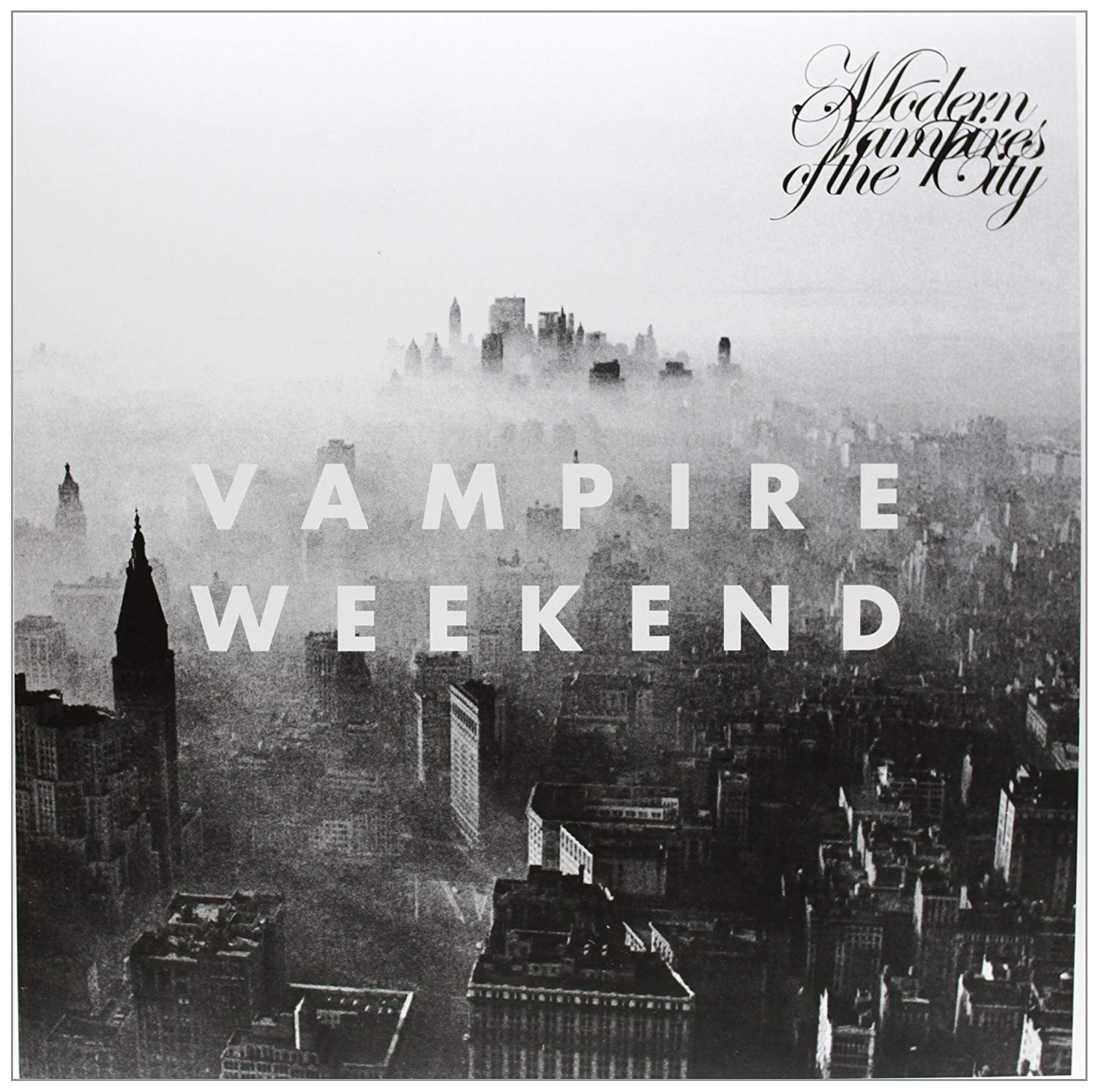
Album Assignments: Modern Vampires Of The City

The band may be called Vampire Weekend, and they may have titled their third album Modern Vampires Of The City, but just between us, I don’t think they’re really vampires. I can tell, because much of the album focuses on a couple of topics that vampires just can’t relate to: God and mortality.

I remember hearing an interview with Pete Townshend where he revealed that “Who Are You” was addressed not to his fans, or himself, but to God. Mind you, he’s said other things about it too, but this was the one that made an impression on me. I found it a pretty startling revelation, given that the song doesn’t exactly come across like a prayer. Similarly, U2’s “Mysterious Ways” could as easily be a love song as a religious paean, or perhaps the other way round.

Vampire Weekend pull off this trick a few times on Modern Vampires. “Worship You” gallops along at a frantic pace, with Ezra Koenig rattling off the verses as fast as humanly possible, addressing someone accustomed to having everything “only in the way you want it.” The chorus slows down enough to be understood, but the words are oblique enough that they could be about a deity or any elevated figure, or even a concept. Similarly, “Finger Back” tears off verse after verse about punishment and pain, but that could be relationship pain as easily as spiritual pain. The spoken aside about an Orthodox girl who “fell in love with the guy at the falafel shop” brings the two together — relationship pain caused by spiritual pain. Or perhaps the other way round.

Album cover for Modern Vampires of the City

“Ya Hey” gets a little more clear, and a lot more clever. Obviously, the title flip-flops Outkast’s “Hey Ya!”, but there’s more going on here than casual rearrangement. Check out this chorus:

Through the fire and through the flames (Ya Hey, Ya Hey)
You won’t even say your name (Ya Hey, Ya Hey)
Through the fire and through the flames
You won’t even say your name
Only “I am that I am”
But who could ever live that way?

The fire, the flames, and the “I am that I am” refer pretty clearly to the story of the burning bush in Exodus 3, which means that “Ya Hey” isn’t just Outkast in reverse. It’s Yahweh, who when asked for his name, tells Moses: “I am that I am.”

And indeed, who could ever live that way? Who could be in a relationship with someone who won’t even tell you his name? “Ya Hey” takes shape as an “I’m just not that into you” song, giving a potential lover the brush-off, except this time the suitor is the Christian god. “Ya Hey” sums up Yahweh’s dilemma: “The faithless, they don’t love you / The zealous hearts don’t love you / And that’s not gonna change.”

“Unbelievers” presents the other side of this dilemma: a narrator who can’t believe, but longs to be saved nevertheless:

Got a little soul
The world is a cold, cold place to be
Want a little warmth but who’s gonna save a little warmth for me?

Believers can warm themselves with the fervent heat of faith, but agnostics and atheists are on their own. The narrator is clearly in a relationship, but with another unbeliever, and he predicts their fates with a paradox: “We know the fire awaits unbelievers.” Of course, unbelievers don’t think that any sort of fire awaits them, and the contradiction plays into a larger theme of questioning atheism. After all, half the world believes, and how does he know which half is right? If there’s even a drop of holy water to be had, maybe belief is worth it after all?

“You and I will die unbelievers” brings the album’s religious concerns together with its other prominent theme: mortality. In “Don’t Lie”, the narrator soberly notes that “God’s loves die young”, and that “there’s a headstone right in front of you / And everyone I know.” The ticking clock of that song shows back up in “Hudson”, which tells the story of another death, and proclaims “the clock is such a drag.”

“Diane Young”, like “Ya Hey”, covers its subject with the thinnest veneer of wordplay. The verses tell a story of an out-of-control friend who keeps courting death, so anybody listening to the song knows very well that “Diane Young” is really “Dying Young.” “It’s bad enough just getting old,” the song tells us, when nobody knows what the future holds, but surely dying young is even worse.

So Modern Vampires Of The City dives pretty deep lyrically, but on a musical level it stays fun, engaging, and refreshing. It sets up a tent somewhere on the road between The Shins’ melancholy grandeur and the effervescent joy of world-music-era Paul Simon. I especially love the piano, featured on “Young Lion”, and the classical-style organ that comes out in songs like “Step.”

I’m pretty firmly in the camp of unbelievers, but I’m also long way from making peace with mortality, and this assignment is a perfect example of why. I’d never listened to much Vampire Weekend before Robby assigned me this album, and now that I have, I need to hear the rest. So there’s yet another set of experiences I have to chase down before I die. Forget Diane Young — even Diane Old will never give me enough time to hear, read, play, and see everything I want to. The clock really is such a drag.

Album Assignments: Into The Woods

On December 3rd, 1989, Robby and I attended a concert together: The Call at the Glenn Miller Ballroom on the CU Boulder campus. Now, I have been to many a concert over the decades, but to this day I count that show as one of the Top 5 I’ve ever seen. I was already a fan of the band, based on local radio play for “Everywhere I Go” and “The Walls Came Down”, but nothing prepared me for the phenomenal energy pouring off that stage, ricocheting through the audience like chain lightning. The ballroom is not big — it holds maybe 1000 people — and The Call stuffed a stadium’s worth of power into it that night. I’ve never felt anything quite like it.

They were touring on their brand new release Let The Day Begin, whose title track became their most popular song, peaking at #1 on the Mainstream Rock chart (albeit only reaching #51 on the Hot 100), but I am here to declare that the pinnacle of The Call’s staggeringly underrated career is their 1987 album Into The Woods. It’s a breathtaking artistic achievement, with one of the all-time great album sides, suffused throughout with passion, thoughtfulness, intensity, and one spine-tingling moment after another.

Here’s the sonic palette of The Call in 1987:

  • Introspective electric guitar by Tom Ferrier
  • Driving, crashing drums by Scott Musick
  • Elegiac synths by Jim Goodwin
  • Virtuosic bass and astonishing vocals by Michael Been

Been, the group’s primary songwriter, started out on guitar, then shifted to bass a few albums into the group’s career. The result is an aggressive, melodic approach to bass playing that puts the instrument in the foreground, shuffling guitar further back into the mix. Like Sting, like Johnette Napolitano, Been’s facility with the bass gives his band an anchored, thrumming style that provides deep roots for the towering emotions within his compositions.

Album cover for Into The Woods

The alchemy of this mix finds its fullest expression in the opening song of the album, and the best song The Call ever made: “I Don’t Wanna.” The opening seconds hook us with contrast, pitting a high, keening synth sound against tentative bass. Then Been’s baritone comes in with what seem like the words to an anti-love song:

I ain’t here to hold you when you cry
I ain’t here to hold your shaking hand
I ain’t here to look you in the eye
Or beg for you to understand
I ain’t gonna walk you through your dreams
Walk you through this life that we all know
I ain’t here to listen while you speak
I ain’t here to heal your broken soul

Been takes a breath, then sings an anguished question that takes the song around a sharp corner: “Am I here at all?” Suddenly, the music leaps to life. Drums propel us forward, the bass quests outward, and guitar fills in the colors. We fly into another verse of resistance:

I ain’t here to tell you what you need
I ain’t gonna take a noble stand
I ain’t here to look you in the eye
Or beg for you to understand
I can only tell you what I’ve seen
I can only tell you how it felt
When my heart is crushed so bad inside
Till I felt the hate that slowly built
I don’t wanna

Now the song is in full swing, the guitar creeping higher atop the swirling bass and drums. What is this about? “I don’t wanna” what? What is the character fighting so hard against? Is it an “It Ain’t Me Babe” song, pushing back against somebody’s idealization of him? Maybe, but what about this crushed heart? This character isn’t just giving somebody the brush-off — he’s in anguish, as Been communicates exquisitely in his rendering of the lines. So what’s happening? Listen:

I ain’t gonna watch your every move
I ain’t gonna dog your every step
I ain’t here to shape your every mood
I ain’t here to keep your secrets kept
Oh but if I held you in my arms
If I could squeeze you till we cry
I don’t wanna lose this love I feel
I don’t wanna lose this fight tonight
I ain’t gonna

And here it is. Just as the instruments take flight after the first verse, Been’s voice leaps to another level on “Oh but if I held you in my arms,” as the character’s true emotion comes to light. He wants nothing more than to hold that shaking hand, to heal that broken soul, but there is something in his way. The overwhelming love and desire he feels is smashing him into that barrier, crushing him, and yet he refuses to let it go. The drums are pounding now, a cymbal crash plummeting into huge tom hits, the guitar skating across the surface into urgent solos, the synths reaching ever higher. And the relentless bass drives more, more, more struggle, repeating the inevitable and praying for the impossible:

I ain’t here to hold you when you cry
I ain’t here to hold your shaky hand
I ain’t here to look you in the eye
I don’t want you under my command
I can only hope you feel your tears
I can only wish you’d feel the hope
I can only hope that I can see
Out beyond this skin that covers me
Oh how I wish that you were here
If I could hold you in my arms
Oh how I wish that you were mine
I don’t wanna beg for you no more

Once again, Been ratchets up the passion on “how I wish that you were here”, and finally at the end of this verse, we hear “I don’t wanna” connect with its object: “I don’t wanna beg for you no more.” Those words contain all the contradictions of the song so far, because obviously the character is doing the very opposite of begging — he’s been fighting like mad to get away from his feelings, but that refusal is a skin that covers over his true emotions, a skin that he wants to remove but that is the only thing protecting him from unbearable pain. Been is nearly shouting at this point, but he reaches his true peak in the next lines:

I ain’t gonna tell you how I feel
I ain’t gonna pray for you to love me
Because I know you will
I JUST KNOW IT!

Right after “pray”, Musick hits two enormous cymbal crashes and plays a crackling fill over “I just know it”, where Been really is shouting. You can hear the character writhing in pain as the song reaches its climax, and then Ferrier’s guitar starts playing arpeggios as a denouement, slowly winding down until the synths can descend, as our heart rates return to normal after an unbelievably intense emotional journey.

Now, it won’t do to give every song this treatment, but I wanted to go in depth on “I Don’t Wanna” so that I can explain the tremendous power of this band. At their best, they could go toe-to-toe with U2, Springsteen, or anybody you care to name in the realm of passion, emotion, and intensity. They engage with big themes, and they bring big music to match.

In “It Could Have Been Me”, Been explores the existential quandary of arbitrary fate, the notion that it is mostly chance that separates the privileged from the homeless, the dead soldier from the living prisoner. Jungle drums strain against (somehow) jangling bass to underscore these divergent paths. “In The River” starts with a dynamite bass riff (where The Call has riffs, they’re bass riffs) and dramatizes contrasts in a new way, with Been and Musick trading vocal lines. Its story of a river encompasses baptism, loss, mortality, and a literal flood that symbolizes humanity’s basic lack of control in the face of overwhelming forces. “The Woods” brings all the instrumental pieces together to paint a vivid portrait of “the night of the soul”, the title woods standing in for depression and despair whose only antidote is “the right word, said from the heart.”

Those four songs together make up Side One of Into The Woods, and it is a flawless album side. “I Don’t Wanna” is peerless, but every other song on the side hits its mark perfectly, and the whole suite of music blends together into an artistic expression nothing short of superb. Side Two is one or two steps down from this level, which is of course still amazingly great — just not quite the triumph that Side One achieves. (And yes, I’m ignoring the CD experience, because this is one of those albums that splits very clearly into vinyl sides.)

So where Side One of the album is incomparable, Side Two suffers in comparison by being merely very good. But every song on that half of the album still has its moments, many of them brought about by Been’s extraordinary vocals. “Day Or Night” bristles with energy, cresting with Been’s “I wanna know your mind’s on me,” and whenever he hits the title in the chorus. “Too Many Tears” lets Been belt out a wonderful image: “I’ve poured myself out like an old bitter wine.” In “Expecting”, Been emotes his way through a different version of the “I Don’t Wanna” dilemma, in which he waits for his lover to finally come to him, and lets the music buoy him as he sings, “Words so often fail.”

Been’s voice is as deep as his lyrics, and almost every song on this album counterpoints this voice with Goodwin’s high synths, to great effect. The contrast gives The Call’s songs a wonderful tension, the feel of a soul straining at its bonds. The exception is the last song on the album: “Walk Walk.” Synths are nowhere to be heard, and the whole things has an entirely different feel from every other song on the album — a gentle rockabilly groove that struts through the song’s central image of walking and learning at the same time. Where so many of the songs on Into The Woods enact entrapment and helplessness, “Walk Walk” is hopeful and propulsive, pushing its narrator into the future. As satisfying as The Call’s anguish has been, the hope of this last track is a welcome harbinger of a path out of the woods, into the sunlight.

Album Assignments: Darkness On The Edge Of Town

The stakes are high in Darkness On The Edge Of Town. The characters aren’t always literally fighting for their lives, but they are absolutely fighting to protect their vitality, their joy, their life-force, from a world constantly encroaching on them. The stakes aren’t life or death, but they are life versus death.

“Badlands” lays out the thesis. Its narrator faces danger on every side — he’s caught in a crossfire, with trouble in the heartland looming, while he gets his back burned working in the fields, feeling a head-on collision smashing in his guts, man. All these forces combined make up the metaphorical Badlands in which he lives, constantly trying to grind him into meaninglessness. But his response is defiant — he reaches for love, faith, and hope, moves from fears to dreams, and embraces the notion that “it ain’t no sin to be glad you’re alive.”

That’s the triumph of the life force, right there. Springsteen and his band imbue the sentiment with anthemic power — driving rock and a passionate vocal. “The Promised Land” extends “Badlands”‘s musical approach as well as its themes, with a narrator who is pretty much identical to the “Badlands” guy. He works all day, assailed by feelings of helplessness, pain, and despair. He sees himself facing down a tornado ready to blow away his dreams… except.

Except he keeps returning to his core, and it is a core of faith. Not religious faith (though some of it is cloaked in religious language), but the belief that things can get better. That the dreams that get blown away are in fact lies if they don’t have the faith to stand their ground. That those dreams and lies deserve to get blown away, because their falseness otherwise stands ready to break his heart. That despite the storm that threatens him, he can drive straight into it and survive, protected by his belief in a better life, and a better future — the promised land.

Album cover from Darkness on the Edge of Town

Every song on the album plays out some version of this battle — death vs. life, darkness vs. light. Sometimes it’s in a romantic context, as in the breathtaking “Candy’s Room”, where the darkness in her hall is the sadness in her face, but she finds hidden worlds alive inside when she’s with her boy. “Prove It All Night” is the companion to this song, in which the life force is decidedly erotic, and the narrator kisses his lover to seal their fates, taking them into the world where they can live… and die.

Sometimes the darkness gets the upper hand, as in “Something In the Night”, where the characters lose everything they love, and end up “running burned and blind.” Or “Factory”, which puts death in the eyes of its workers, sending them home to pass their pain along to somebody else. That pairs directly with “Adam Raised A Cain”, in which “Daddy worked his whole life for nothing but the pain”, and his son finds himself having to rebel or die.

I seem to be finding a lot of pairings on this album, so let me suggest one more: the bookends of “Badlands” and “Darkness On The Edge Of Town.” “Badlands” feels like the beginning of a life, with a narrator full of hope and fire, but “Darkness” feels like the end, its narrator looking back with regret at the wife, the money, and the life he lost. The darkness keeps rising up, that anti-life that may even be a little seductive, and like many of the characters on this album, he’s ready to “pay the cost” for being seduced by it.

The most interesting, though, of all these, is “Racing In The Street,” in which both the stakes and the narrator change partway through the song. We start out with lyrics that feel like they could have been plucked from a Beach Boys record, but sung slowly and gravely. Bruce here is engaging with a long rock and roll tradition of fast cars as symbols of freedom and joy, but undercutting it with the tone of the song, much like Tracy Chapman would ten years later. Then he makes the comparison explicit by quoting Martha And The Vandellas’ “Dancing In The Street” twice, but with a style that is diametrically opposed to Motown exuberance.

Once again, living and dying are on the line:

Some guys they just give up living
And start dying little by little piece by piece
Some guys come home from work and wash up
Then go racin’ in the street

The narrator finds his joy and vitality in these street races, his pride in shutting up and shutting down his competitors. He even finds love in these races, winning his girl after winning a race against her date. But then we learn something unexpected. She cries herself to sleep at night now. She worries about his safety. She stares off alone into the night, deeply unhappy and alone while he goes out racing.

And when he finally figures this out, the narrator leaves behind his world of “shut-down strangers and hot rod angels” to focus on what really matters in his life: love. He puts the power of his engine into the service of taking the two of them somewhere they can find redemption and a fresh start. For all the exultation of songs like “The Promised Land” and “Prove It All Night”, I would argue that the greatest triumph of life on the album happens at the end of “Racing In The Street.”

I’ve been focused on the songwriting of this album, because that’s what I connect to the most, but before I close, let me just add one more page to my already extensive Roy Bittan fan book. Sure, the entire band is wonderful, and Bruce’s vocals are great, sometimes bordering on scary great. But for me the piano feels like the emotional core so often. Can you imagine the beginning of “Prove It All Night” without Bittan? Or “Badlands”? Or “Something In The Night”? Or “Candy’s Room”? I sure can’t. Even songs that don’t feature the piano so prominently, like “The Promised Land”, benefit hugely from the beautiful underpinning that The Professor provides. Springsteen’s lyrics are the star of this album, but they wouldn’t shine anywhere near as brightly without the brilliant Roy Bittan.

Album Assignments: Bare Trees

For its most recent tours, Fleetwood Mac replaced Lindsey Buckingham with a new singer (Neil Finn) and a new guitarist (Mike Campbell.) Now, I’ve seen Fleetwood Mac lots of times, in lots of configurations, and I’ve also seen Lindsey on his own, and with Christine McVie. If you lean in close, I’ll whisper something to you, something heretical among a lot of Fleetwood Mac fans: I’ve kind of had it with Lindsey.

Sure, I appreciate him as a guitarist, as a songwriter, and as a producer, especially on Rumours, Tusk, and Mirage. But I’ve also listened to his endless pontifications and solos from many a stage, and I’ve read numerous sources that detail his abusive, controlling behavior. In fact, the band’s excuses for dismissing him were so threadbare that I really wonder if his firing was actually connected to the #metoo movement, which happened to peak right around the time they made the announcement. In any case, for me it was really listening to and writing about Lindsey Buckingham Christine McVie that crystallized my perception that he’s been standing on Fleetwood Mac’s neck for the last 20-odd years.

Well, seeing Fleetwood Mac without Lindsey Buckingham on these last tours was quite a revelation. Here’s what I wrote about it the night after the first Lindsey-less show I saw:

Have you ever gotten out of a toxic relationship and found pieces of yourself coming back to life, pieces you’d shut down, maybe without even fully realizing it? Like opening the windows of long-sealed rooms and letting the outside air in at last? That’s what it felt like to see Fleetwood Mac in concert without Lindsey Buckingham.

Apparently, without Lindsey in the mix, Fleetwood Mac can acknowledge that it existed before he arrived! Can Stevie sing “Black Magic Woman”? Sure, why not? Can Mike Campbell play and sing “Oh Well”? You bet! Can Fleetwood Mac play a Danny Kirwan song in 2018? HELL YES.

Album cover art for Bare Trees

And that brings us at last to Bare Trees. Fleetwood Mac released this album in 1972, back when they were just a working band rather than an international sensation and cultural juggernaut. The lineup, besides Mick and John, was Christine McVie, Danny Kirwan, and Bob Welch.

In a previous post, I called Welch “criminally underappreciated”, and I stand by that statement. Welch was a great musician and songwriter, and was responsible for some of the best Fleetwood Mac songs between the Green and Buck/Nicks eras. But for whatever reason, he gets consistently ignored in retrospectives of the band’s history, and was unconscionably snubbed when Fleetwood Mac was inducted into the Rock And Roll Hall Of Fame. Sadly, he died by suicide in 2012.

The thing is, it’s hard to appreciate Welch within the confines of a single Fleetwood Mac album. His best stuff was spread across the albums from his tenure — “Lay It All Down” and “Future Games” from Future Games, “Did You Ever Love Me” (with Christine) from Penguin, “Emerald Eyes” and the wonderful “Hypnotized” from Mystery To Me, “Silver Heels” and “Bermuda Triangle” off Heroes Are Hard To Find. But Bare Trees has one of his all-time classics, “Sentimental Lady”, a song he re-recorded and had a Top Ten hit with on his 1977 solo album French Kiss.

I confess to preferring the solo version, partly from childhood familiarity and partly because I love Christine singing “all I need is you” at the end of the chorus. But the Bare Trees version is charming too, with Christine singing an intriguing countermelody across the chorus. Lyrically, too, the Bare Trees version is superior, as it retains a full verse that got cut from the solo version — “we live in a time when paintings have no color, words don’t rhyme.”

Welch was pretty sentimental himself, given to emotional mysticism and spooky imagery, as in his other tune on Bare Trees, “The Ghost.” Where the wind in “Sentimental Lady” is gentle, it’s a “strange wind” that haunts this song. Where “Sentimental Lady” is about holding on to love in the face of threatening odds, “The Ghost” is about the threat of, well, nuclear holocaust. “And then the winds start to blow / And the fire comes scorching down / And then the sky disappears / In the cloud with an awful sound / And when you can’t hold out / Then you run to the underground.”

Compared to this, Christine McVie’s troubles seem pretty small, but they’d loom large in the future of the band. Even in 1972, she told us in “Homeward Bound” that she’d rather be at home in her rocking chair than traveling the world. It wasn’t until 1998 that she made good on that conviction, quitting Fleetwood Mac for about 15 years. “Spare Me A Little Of Your Love” is her highlight on this album, a sweet love song leavened with just enough of McVie’s trademark ambivalence.

In the end, though, this is Danny Kirwan’s album. He has more songs on it than Welch and McVie put together, including the title track. Kirwan’s another one whose best stuff is pretty well distributed across albums (really, they all are), including the tune performed by the band on its recent tours (“Tell Me All The Things You Do”, from Kiln House) and the excellent “Trinity”, which somehow never made its way into the light until the band’s 1992 box set. Bare Trees was his swan song with the band, though — he was destined for one of Fleetwood Mac’s many strange and sad endings, fired from the band for his excessive alcoholism and a violent backstage incident, and homeless for much of the 1980s and 90s.

His intensity and lyricism are in full flower on this album, as is his deft way with a melody. In fact, two of his five tunes are instrumentals, with “Sunny Side Of Heaven” being a particular knockout. Woven between them is the story of a full life. The album opens with “Child Of Mine”, a poignant declaration of love for his infant son. Eight songs later, Kirwan closes with “Dust”, an ode to death with lyrics from the first two stanzas of Rupert Brooke’s 1910 poem.

Kirwan’s stuff here is serious, but I’d never call it bleak. His melodies are too joyous, his playing too passionate, for such a label. Really, that applies to the whole album. Where John McVie’s cover photo depicts a world stripped of life, looking almost like a misty Dante-esque purgatory, Fleetwood Mac’s cascading synchrony of songwriting, vocals, guitars, and rhythm section feels more like the sunny side of heaven.

Album Assignments: Scarecrow

Lou Reed may have grabbed first dibs on the title Growing Up In Public, but John Mellencamp perfected the art of it. Once upon a time, John J Mellencamp of Seymour, Indiana had a rock and roll dream. In chasing it, he found himself rebranded as “Johnny Cougar.” After a few failed albums and a label change, he broke through with a song, “I Need A Lover”, and an eponymous album, where at least he managed to upgrade from “Johnny” to “John”.

There were a few more John Cougar albums, a few more hits, and a bigger breakthrough with “Hurts So Good”, “Jack and Diane”, and MTV. With some star power on his side, Mellencamp managed to reclaim his last name, appending it to his stage name to forge the awkward Frankenym “John Cougar Mellencamp”. 1983’s Uh-Huh was his first album under this name, and also the first album where he started to stake out the artistic identity that would provide the foundation for the rest of his career.

Album cover for Scarecrow

Now, I love those early John Cougar albums, especially the first two. (Never sought out the “Johnny” stuff, though.) And I dig American Fool and Uh-Huh, particularly the singles. But to me, Scarecrow is Mellencamp’s artistic peak. He did plenty of great work beforehand, and plenty of great work afterward, but Scarecrow captures a magic that stands above the rest, because it’s the album where he first fully owned all the aspects of himself that lend power to his art. It’s the album where the seeds planted on Uh-Huh fully ripen, and I like to think John would appreciate the agricultural metaphor. This album springs from fertile ground, both artistically and literally. Mellencamp’s childhood friend and frequent songwriting partner George M. Green described it this way:

The highway between John’s house and the studio where these songs were recorded cuts through a stretch of Indiana where the land is fertile and full of growth. It is from this land and its people that these songs are born, and though it is not necessary to know this to enjoy and appreciate them, it does lend a certain understanding for those who care to think about such things.

Which brings us to the first aspect of John Cougar Mellencamp that shines on this album: RURAL. Mellencamp had written plenty of songs set in rural America — witness the Tastee Freez in “Jack and Diane” — but “Pink Houses” from Uh-Huh was the first of his rural anthems. Scarecrow unleashes two more stunners in this genre, with “Rain On The Scarecrow” and “Smalltown”. In the former, he reminisces about his grandfather (to whom the album is dedicated), and rails at the way 1980s society has failed the family farm.

In the latter, he honors his rural identity, exulting in the small town where he can be himself, albeit in a way that’s clear-eyed about its shortcomings — such as how he was “taught to fear Jesus.” In between, he records his grandmother crooning the first two verses of an old folk tune, “In The Baggage Coach Ahead.” This is Mellencamp fully embracing his roots, the pieces of him underneath “John Cougar”, and while “Smalltown” is celebratory, “Rain” is angry, in a way we haven’t seen before from Johnny Cougar.

That blistering anger opens the album, announcing that this wouldn’t be just a typical roots-pop exercise. It also sheds light on another of Mellencamp’s traits: REBELLIOUS. Once again, Uh-Huh laid the groundwork with “Authority Song”, and to a lesser extent “Crumblin’ Down”. On Scarecrow he stopped singing about being a rebel and started singing in a more rebellious way, starting with “Rain On The Scarecrow.” The political tone from that song continued through “Justice And Independence ’85” and “The Face Of The Nation.”

Both of those tunes are allegorical and a bit clunky lyrically, but they are venturing a critique of contemporary America, which was new territory for Mellencamp. The guy who wasn’t even recording under his own name in the beginning of his career had found his way towards claiming a voice of protest. “You’ve Got To Stand For Somethin'” wasn’t really about this very much (ironically), but its title certainly sums up what Mellencamp seems to have concluded about his art.

Though he hadn’t fully matured this political voice, he more than made up for any deficiencies by being such a ROCKER. Where on Uh-Huh he sang about how he loved to “Play Guitar”, and made sure we knew that rock and roll was “Serious Business” for him, on Scarecrow he expanded out to the whole musical world with “R.O.C.K. in the U.S.A. (A Salute To 60’s Rock)”. This song joyfully conjures the rock and soul dreams of a generation of musicians, in a deliberately inclusive way, name-checking black and white, male and female, solo and group, pop, rock, and soul. As fun as that salute is, Mellencamp still shows more than he tells when it comes to rocking, roaring through this album’s set with a crack group of musicians.

In particular, I have to bow to the prowess of drummer Kenny Aronoff, who is responsible for some of the most stirring moments on the album. The pounding, martial drumbeats of “Rain On The Scarecrow”, which get louder and louder until they crest with six powerful hits, provide a spine-tingling opener to the record, and Aronoff remains excellent throughout. He and rhythm guitarist Larry Crane rescue “Justice And Independence ’85” from what could be a bit of a wincer into an electrifying rock and roll song. And it’s Aronoff who propels the other big hit from Scarecrow, “Lonely Ol’ Night.”

That song finds Mellencamp in another space he’d touched on Uh-Huh, that of the ROMANTIC. Where “Golden Gates” on that album spoke of “promises made from the heart”, in “Lonely Ol’ Night” he paints the picture of a whole relationship, one of necessity and maybe a little love. But his romantic nature mostly isn’t about relationships, but rather the kind of artistic and literary Romanticism I talked about in the Making Movies post.

It’s a romantic figure who occupies “Rumbleseat”, somebody who moves from being a “pitiful sight” to being a dreamer “singin’ shotgun”, who’ll blow you a kiss as he goes by. The insistence that “You’ve Got To Stand For Somethin'” is pure Romanticism, as are the heroes described in “R.O.C.K.” — “pipe dreams in their heads and very little money in their hands.” In fact, I’d say he’s on surer ground here than when talking about relationships — the other relationship song is the closer and the one stinker on this album: “The Kind Of Fella I Am”, which seems to take pleasure in being toxic and controlling. It’s a bit reminiscent of how “Run For Your Life” leaves a foul taste at the end of Rubber Soul.

But as great as all these aspects are, by far my favorite side of John Cougar Mellencamp is when he turns RUMINATIVE, as he does in Scarecrow‘s two best tracks: “Minutes To Memories” and “Between A Laugh And A Tear.” The latter is a rueful meditation on life, with some great images — “smile in the mirror as you walk by” — and one of the best lines in Mellencamp’s entire oeuvre: “I know there’s a balance / I see it when I swing past.” Rickie Lee Jones provides wonderful harmony vocals, and the whole thing provides a lovely, uplifting message. Living between laughter and tears may be as good as it gets for us, but “there ain’t no reason to stop tryin’.”

“Minutes To Memories” pulls all the strands together. It’s the story of a Greyhound bus ride from Jamestown, Kentucky to Seymour, Indiana, sitting beside an old man telling the story of his life. It is rural as can be — “through the hills of Kentucky / Across the Ohio river”, with downhome aphorisms like “an honest man’s pillow is his peace of mind.” Mellencamp’s narrator is a rebellious, romantic figure, whose credo is, “I do things my way, and I pay a high price.” The old man himself is romantic too, in his way — a fierce individualist who says, “I earned every dollar that passed through my hands,” and who will carry his family and friends home “through the eye of a needle.”

The lyrics ruminate on nothing less than the meaning of life, but ultimately what makes this song work is the rock. It starts out midtempo, a contemplative riff with support from Aronoff and bassist Toby Myers, and then it builds to the vivid, inspiring chorus, infused with rock and roll power:

Days turn to minutes, and minutes to memories
Life sweeps away the dreams that we have planned
You are young, and you are the future
So suck it up, tough it out, and be the best you can

Yeah, on paper I guess it sounds like platitudes, but between Mellencamp’s fantastically committed vocal and the incredible power of the band, it becomes, I think, the high water mark of John Cougar Mellencamp’s career. I get chills every time I hear it, and I’m filled with gratitude that Mellencamp managed to find his way to such a mature expression, and managed to fill it with the crazy rock potency of his youth.

The Watchmen Bestiary 27 – The Righteous With The Wicked

In the beginning, there were Watchmen spoilers. There will also be Watchmen spoilers throughout.

We’re on to Watchmen Chapter 3 in the Bestiary, and with a new chapter comes a new chapter title and a new epigraph. While the first two epigraphs came from the world of rock and roll, Chapter 3 casts much further backward, all the way back to the first book of the Bible — Genesis, chapter 18, verse 25: “Shall not the Judge of all the earth do right?” (Note that this is the King James Version [KJV] translation.)

Quote from the bottom of page 28, chapter 3: "Shall not the Judge of all the earth do right?" -- GENESIS chapter 18, verse 25

We’ll get to what this means for Watchmen in a moment, but first let’s take a little time to ascertain the Biblical context of the quote. Genesis splits roughly into two parts, known as the Primeval History (chapters 1-11) and the Patriarchal History (chapters 12-50). The Primeval History narrates the creation myth, Adam and Eve, Cain and Abel, Noah’s ark, and the Tower of Babel. Lots of greatest hits. The Patriarchal History, on the other hand, starts with Abram (later called Abraham), then traces his lineage down through a series of patriarchs, in particular Abraham’s son Isaac, Isaac’s son Jacob, and Jacob’s son Joseph. The book tells a handful of stories from each man’s life, culminating in the “Joseph Novel”, which occupies (more or less) chapters 37-50.

Chapter 18, then, is early in the Patriarchal History, in the midst of the stories of Abraham. In this chapter, we find Abraham sitting in his tent, enduring the day’s heat, when he notices three men standing in front of him. Somehow sensing that there is more to these men than meets the eye, Abraham abases himself to them, begging them to partake of his hospitality. When they assent, he has his wife and his servants whip up the finest possible meal for them.

Very quickly, the text makes it clear that Yahweh (translated in various versions as “the LORD”) is among these men, a physical manifestation of the Israelites’ God, who had previously appeared to Abram in visions. After some conversation establishing that Abraham’s barren wife would in fact bear a child (and explaining the origin of the child’s name), the men walk out to look from afar at the city of Sodom. Yahweh wonders, “Shall I hide from Abraham what I am about to do, seeing that Abraham shall surely become a great and mighty nation, and all the nations of the earth shall be blessed in him?” (All textual quotes are from the English Standard Version, except where noted.)

Yahweh decides against deception, and lets Abraham know that he intends to evaluate the cities of Sodom and Gomorrah, having heard that “the outcry against [them] is great and their sin is very grave. I will go down to see whether they have done altogether according to the outcry that has come to me.” Now, this is a bit of an odd statement for a deity generally depicted as all-knowing. Yahweh is unusually personified in this section, and seems to share (for the moment) the general human trait of limited knowledge, and the need to investigate to learn more. Various Biblical scholars have come up with rationales to explain this seeming paradox, suggesting that perhaps God was teaching us not to pass judgment before investigating the evidence, or that “if one’s actions are unworthy of God, one is said to be unworthy of his knowledge also.” (Ancient Christian Commentary On Scripture: Old Testament II, pg 68-70)

Whatever the case, Yahweh has a more human presentation than usual, which perhaps emboldens Abraham to approach him on a human level, attempting to haggle over amounts, as was common in his culture. “Will you indeed sweep away the righteous with the wicked?” he asks. “Suppose there are fifty righteous men within the city. Will you then sweep away the place and not spare it for the fifty righteous who are in it?” Warming to his theme, Abraham amps up the rhetoric: “Far be it from you to do such a thing, to put the righteous to death with the wicked, so that the righteous fare as the wicked! Far be that from you! Shall not the Judge of all the earth do what is just?” Or, as the KJV would have it, “Shall not the Judge of all the earth do right?”

Panels from the R. Crumb comic illustrating this story, starting with Abraham standing before the Lord, and ending with Abraham beginning to haggle

Panels from R. Crumb’s illustrated version of this story. Translation by Robert Alter et. al.

Abraham argues Yahweh all the way down to ten righteous, and Yahweh agrees, “For the sake of ten I will not destroy it,” which brings Chapter 18 to a close. Then comes Chapter 19, in which “two angels” arrive in Sodom (seemingly without Yahweh in tow after all), and get harassed by a pack of xenophobes. We don’t get the sense that any kind of thorough examination of the city occurs — there’s no story of seeking righteous people. The text does specify that “the men of the city… all the people to the last man” are part of the mob — apparently women didn’t count in the righteousness census. (And I guess it’s a pretty small city?) In any case, the angels warn in short order that “we are about to destroy this place,” and indeed that morning Sodom is destroyed, with only Abraham’s nephew Lot and his family escorted from the destruction. The Judge of all the earth renders his judgment and punishment, Abraham’s bargaining notwithstanding.

A Panel Of Judges

In Chapter 3 of Watchmen, there are several candidates for “Judge of all the earth.” The first of these is God himself. In the very first panel, Bernie the news vendor asserts, “We oughta nuke Russia and let God sort it out!” Then, a few panels later, the Tales Of The Black Freighter narrator touches a similar theme: “In despair I sank beneath those foul, pink billows, offering up my wretched soul to almighty God, and his judgment.” Later on, that same character concludes that this judgment is in the negative: “I cursed God and wept, wondering if he wept also. But then, what use his tears, if his help was denied me?” The doomsayer (who has not yet been revealed to be Kovacs/Rorschach) doesn’t mention God explicitly, but seems to look to the sort of mysterious signs (“a two-headed cat born in Queens”) that doomsday cults use to predict divine punishment of humanity.

In the context of the Genesis quote, these notions of God’s judgment look rightly ominous. This is the same God who rained down fire on an entire city after his emissaries concluded that there weren’t even ten righteous people (sorry, MEN) within it. No wonder that invocations of his judgment don’t allow much latitude for the possibility of mercy. Yet at least in vendor Bernie’s quote, it isn’t really God who wants to rain down fire — it’s Bernie himself, just using God as a convenient prop to wave away the horror, and suggesting that if humans nuke each other, some higher power will “sort it out.” That brings us to the second category of judge in this chapter: humans themselves.

Late in the chapter, we see Richard Nixon close to following vendor Bernie’s advice. He stares at the Dr. Strangelove map board, contemplating the judgment he could render on Russia, and incidentally Europe and half the U.S. as well. Benny Anger’s audience is in on the bloodthirst too, asking Dr. Manhattan, “If the Reds act up in Afghanistan… will you be prepared to enter hostilities?” to widespread applause. Perhaps we expect a distant God to destroy us in judgment for our sins, but at least as this chapter depicts us, we are scarcely safer when left to our own devices.

Then there is Dr. Manhattan, who is between the poles of divinity and humanity — a human with godlike power, whose changed perceptions remove him further from humanity all the time. Certainly the Russian government seems to have viewed him as, if not a judge, at least a sort of referee, preventing hostile parties from “acting up.” As soon as the news hits that he’s left for Mars, Russia immediately invades Afghanistan (or perhaps counter-invades, given the references to “U.S. adventurism” there in Chapter 1.) Likewise, the U.S. government sees him as “the linchpin of America’s strategic superiority,” a judge who’s already in their pocket, at least until he disappears. Benny Anger’s audience seems to view him as more or less a weapon to be used by the U.S. at will.

So is he a judge? The chapter’s epigraph appears beneath his picture, which certainly suggests that he may be that “Judge of all the earth.” Yet throughout the chapter, he shows poor judgment over and over. Certainly he badly misjudges Laurie’s reactions, both when trying to “stimulate” her, and when talking with her afterwards. Janey Slater seems to have his number when she says, “You know how every damn thing in this world fits together except people!” He apparently becomes convinced during the Nova Express Q&A that he radiates death, and that night judges himself “incapable of cohabiting safely either emotionally or physically.” If he is Earth’s judge, it’s only inadvertently — his presence or absence is as near as he comes to action for or against the planet, and as Laurie well knows, even when he’s present, he can be pretty absent.

The fourth, hidden judge turns out to be Ozymandias, who will in fact rain destruction down upon a city just as the God of Genesis does, but with no intercessor Abraham to plead for the innocent. In fact, Adrian Veidt makes certain that nobody knows about his plan if they have “the slightest chance” of their affecting its outcome. Where Yahweh debates whether to share information with Abraham, and ultimately decides to do so, Adrian feels no such compunction.

Side-by-side panels from R. Crumb's Genesis and Watchmen. The Crumb panel shows God contemplating revealing his plan to Abraham. The Watchmen panel shows Ozymandias saying, "Do you seriously think I'd explain my master-stroke if there remained the slightest chance of you affecting its outcome?"

Yet Veidt aspires to transcendence, to godhood. He speaks of assuming “the aspect of kingly Rameses, leaving Alexander the adventurer and his trappings to gather dust.” “My new world demands less obvious heroism,” he sneers, anointing himself a world-creator. He engineers much of the story that the other characters find themselves walking through, an authorial presence from behind the scenes, including the pivotal plot advancement of this chapter — Dr. Manhattan leaving Earth.

He describes himself as motivated by the Comedian during the 1966 Crimebusters meeting, and in turn characterizes Blake’s reaction to his plan as “professional jealousy.” But might Veidt be experiencing some professional jealousy of his own? He lives in the presence of Dr. Manhattan, a being of casual godlike power, but one with a total disinterest in remaking the world. How that must eat at Adrian Veidt. To carry out his judgment on humanity, he must remove Dr. Manhattan from the earth altogether.

As soon as this happens, the chapter fittingly turns to ruminations on the absence of God. It starts with the Black Freighter narrator: “That night, I slept badly beneath cold, distant stars, pondering upon the cold, distant God in whose hands the fate of Davidstown rested. Was he really there? Had he been there once, but now departed?” Then we see the return of the doomsayer, who counters vendor Bernie’s assertion that “the world didn’t end yesterday” with, “Are you sure?” Then, with news of Russia’s Afghanistan invasion, we turn to Nixon and his cabinet discussing nuclear scenarios, and the role played by wind, “a force of nature. It’s totally impartial… totally indifferent.”

By the time the chapter ends, our terror comes not from the notion of God’s punishment, but rather the random, meaningless universe we face without the notion of his presence. His most frightening judgment of all is his decision to leave us on our own, in a world that we can never be sure hasn’t just ended. The cliffhanger ending of the pirate comic sets up the narrator’s tragic actions in the next issue. Perhaps Jon’s unwillingness to stop what Adrian sees as the freighter bearing down on humanity — its penchant for self-destruction — prompts Adrian’s own Davidstown actions?

How Do You Plead?

Chapter 18 isn’t the first time in Genesis that God acts as “Judge of all the earth.” His first mass judgment comes in chapter 6, verse 5:

The LORD saw that the wickedness of man was great in the earth, and that every intention of the thoughts of his heart was only evil continually. And the LORD regretted that he had made man on the earth, and it grieved him to his heart. So the LORD said, “I will blot out man whom I have created from the face of the land, man and animals and creeping things and birds of the heavens, for am sorry that I have made them.” But Noah found favor in the eyes of the LORD.

Once again, one man has the power to sway Yahweh, and that one man will be spared from the judgment that affects everyone else. These judgments, of wickedness and sin, rely on a starkly binary scale for judgment of humans — everyone is either fully righteous or fully wicked. In the Noah story, only Noah is found righteous — his family is spared for its association with him. In Sodom, only Lot is spared, once again with his family as more or less an accessory. This despite the fact that Lot isn’t exactly virtuous — he offers his virginal daughters to the xenophobe mob, hoping to distract them from his visitors. Perhaps Lot is only spared because he is Abraham’s nephew, thus once again allowing a great patriarch’s relations to be saved for the sake of their connections with him.

The righteous/wicked binary of these chapters is typical of the Old Testament (and some parts of the New Testament, notably Revelation.) The same dualism grounds many a traditional superhero narrative, and Watchmen works to break down this simplistic approach. Rorschach embodies Old Testament moral absolutism in Watchmen, and in yet another Biblical inversion, he finds himself the black and white Abraham to Dr. Manhattan’s morally grey Yahweh at the end of Chapter 12. Unlike Abraham, his only plea is for his own death. He is not saved.

Panels 1-4 from Chapter 12, page 24 of Watchmen. Rorschach realizes that Dr. Manhattan is going to kill him, and screams at him to do it. Manhattan vaporizes Rorschach.

In Genesis, Abraham’s role as bargainer goes well beyond chapter 18. He bargains with Ephron for Sarah’s burial place in chapter 23, and bargains with Lot in chapter 13. We find him in political negotiations at the ends of chapters 14 and 20. He even presumes to plead with Yahweh (in a vision) for a blood heir, in chapter 15.

Yet in all these other scenes, he bargains for himself or his family. In chapter 18, he speaks for a greater humanity. This dynamic gets its Watchmen mirror in Chapter 11, between Laurie and Jon. Yet as usual, it’s a distorted mirror. Laurie pleads with Jon to intercede on humanity’s behalf, to save humankind from itself. Abraham, on the other hand, pleads with Yahweh not to intercede, and to let the righteous, even if they are greatly outnumbered, help influence humans toward a more just path.

They do have in common a sense of false victory. Both Laurie and Abraham manage to sway their gods, but neither of them can stem the tide of slaughter.

Watchmen: Second Genesis

So far we’ve seen how Watchmen offers various judges, including the indifferent Dr. Manhattan and the sociopathic Ozymandias. We’ve seen the moral binarism of Genesis reflected in Rorschach, and we’ve seen the bargaining motif of Genesis both reflected and inverted by Rorschach and Silk Spectre II, as they confront Dr. Manhattan in different scenes.

But Watchmen displays other themes from Genesis, including that book’s strong motif of trickery. Guile and deceit are all over the place in Genesis, and not just in the villainous characters. Sure, there’s the serpent beguiling Eve in the garden, but more often it is the patriarchs themselves who do the tricking. No less than three times (chapters 12 and 20 with Abraham, and chapter 26 with Isaac), a Biblical patriarch convinces a local ruler that the patriarch’s wife is actually his sister. Each time, God afflicts that ruler, even though each time the ruler is the victim of the deception.

In the story of Jacob, Laban, Rachel, and Leah (chapters 29-31), everyone is constantly tricking and swindling each other. Laban tells Jacob to serve him for seven years in order to marry Laban’s daughter Rachel, only to send his other daughter Leah instead, making Jacob serve seven more years for Rachel. Jacob makes a deal with Laban to own all his speckled livestock, then Laban removes all the speckled livestock, then Jacob ensures that more speckled livestock will be born and takes them anyway. Jacob sneaks away from Laban’s estate in secret, Rachel steals her father’s “household gods”, then Laban catches up with them and accuses them of theft, but Rachel fools him by hiding the gods in a camel’s saddle, then sitting on it and saying, “I cannot rise before you, for the way of women is upon me.”

On and on it goes. Jacob’s sons trick Shechem, slaughtering an entire town in revenge for their sister’s rape. Jacob tricks Esau out of his birthright. Joseph’s brothers trick him and sell him into slavery, then he tricks them back after coming into power. Usually it is the agents of God practicing the deception (and giving God credit for the results), but even God himself gets in on the action, tricking Abraham into binding his son Isaac for slaughter before calling him off at the last minute, saying, “now I know that you fear God, seeing you have not withheld your son, your only son, from me.” (Incidentally, Isaac is Rachel’s only son. Abraham has another son, Ishmael.)

There is only one trickster in Watchmen, and his name is Ozymandias. But oh, what a bag of tricks he carries! From the very first moment of the book, he deceives both readers and characters. The murder that spurs Rorschach’s “mask-killer” theory? A trick. The cancer epidemic that drives Dr. Manhattan from Earth? A trick. The assassination attempt on Veidt himself? A trick. The frame job on Rorschach, the (second) disintegration of Jon Osterman, Adrian’s somber face at Blake’s funeral: tricks, tricks, tricks, all in service of his greatest trick of all.

Panel 4 from Chapter 11, page 24 of Watchmen. Ozymandias kicks open the Comedian's door, with voiceover panels reading "Unable to unite the world by conquest... Alexander's method... I would trick it; frighten it towards salvation with history's greatest practical joke. That's what upset the Comedian, when awareness of my scheme crashed in upon him: professional jealousy."

“Unable to unite the world by conquest,” he boasts, “I would trick it; frighten it towards salvation with history’s greatest practical joke.” He seems to truly believe that his brand of trickery is different from that of Genesis, that he is a different sort of patriarch, a different sort of god. Where Biblical characters practice deception to serve themselves — preserve their lives, build their wealth, gain power over others — Veidt’s sees his trick as preserving humanity at large. Where Yahweh tricks Abraham to ensure he fears what is most fearsome, Veidt tricks Earth into fearing the imaginary, so as to direct their fear away from each other.

On the one hand, Adrian’s self-serving belief seems patently ridiculous. His trick kills millions of the humans he claims to be saving. No Biblical patriarch does any such thing. Every wife/sister con gets retracted and the afflicted ruler recovers. Laban steals years of Jacob’s labor, Rachel steals “household gods”, Jacob steals Esau’s blessing from Isaac, but nobody gets killed by these ruses. The slaughter of Shechem’s town is as close as we get, and this happens on a much smaller scale, and for revenge — no pretense of saviorship. Even God makes sure that Abraham spares Isaac.

On the other hand, Watchmen‘s ending is ambiguous enough that we can’t be certain that Adrian is wrong. Perhaps his monstrous machination does save more people than it destroys? That question brings us to the final parallel with Genesis, the notion of good outcomes arising from evil deeds.

In the “Joseph novel”, Joseph’s jealous and hateful brothers sell him into Egyptian slavery, telling their father Jacob that Joseph was killed by a wild beast. While in Egypt, Joseph becomes a powerful prophet, whose prophecies save Egypt from a famine that afflicts everyone else. His brothers come to Egypt begging for food, and after several rounds of the usual trickery, Joseph finally reveals his identity to his brothers, and reunites with his father, who dies peacefully, knowing his youngest son has survived after all. In the end, those brothers worry (quite logically!) that Joseph will bear a grudge, and try — once again — a trick, telling Joseph that Jacob commanded him to forgive them. Joseph responds to them thus:

Do not fear, for am I in the place of God? As for you, you meant evil against me, but God meant it for good, to bring it about that many people should be kept alive, as they are today. So do not fear; I will provide for you and your little ones.

This is the climactic moment of the “Joseph novel”, and the book of Genesis as a whole ends a few verses later. For Joseph, two principles are at work. First, none but God is fit to be “Judge of all the earth.” Second, the harm done by humans can be resolved by God into good, or perhaps more problematically, God prompts humans to harm each other in order to accomplish a greater good down the line. Biblical scholar Bill Arnold sums up the message pretty succinctly: “Joseph represents the conviction that good can come from evil.” (Genesis [New Cambridge Bible Commentary], pg. 389)

This conviction is a central question at the end of Watchmen. Ozymandias believes it, though I doubt he would agree with the concept of an omniscient god prompting his actions. In his mind, he is the omniscient one, or at least the one blessed with a broader perspective than his fellow beings — “the smartest guy in the world.” He feels entitled to be “Judge of all the earth” due to his belief in this greater perspective, and he sees himself as a benevolent shepherd, willing to sacrifice some of his sheep for the good of the whole flock. Rorschach, on the other hand, rejects the notion that good can come from evil. For him, “there is good, and there is evil, and evil must be punished.”

Where does Watchmen itself land? I think it’s closer to Dr. Manhattan, observing it all from Mars. I think it’s closer to this 2003 quote from Alan Moore:

The main thing that I learned about conspiracy theory is that conspiracy theorists actually believe in a conspiracy because that is more comforting. The truth of the world is that it is chaotic. The truth is, that it is not the Jewish banking conspiracy or the grey aliens or the 12 foot reptiloids from another dimension that are in control. The truth is more frightening, nobody is in control. The world is rudderless.

In other words, “Shall not the Judge of all the earth do right?” is the wrong question. There is no “Judge of all the earth” — only us. The real question is, “Shall I do right?” And if so, how?

Next Entry: Mutiny, I Promise You
Previous Entry: Tears Of A Clown

Album Assignments: Pretenders II

I love Pretenders II. I mean, I love this album like loving a person. I’ve known it for over 30 years now. Whenever we get to spend time together, no matter how much, the time always feels too short. It was my companion through some of the most intense parts of my life, and every time I’ve revisited it over the years has been a pure pleasure. I listened to it so much during the writing of Earth And Sky 3 that I gave it a shout-out in a SPAG editorial. It was only a matter of time until I assigned it in this series, so that I could write a tribute to this album that’s meant so much to me.

What is it that’s so special about Pretenders II? That’s the question I was trying to answer as I listened this time, and this record, in its richness, offered up quite a few explanations. The first of these that comes to mind is Chrissie Hynde’s voice. This extraordinary instrument glides effortlessly through a dizzying variety of moods. She snarls on “Bad Boys Get Spanked”, and croons on “I Go To Sleep”. She’s frenetic in “Louie Louie”, nostalgic in “Birds Of Paradise”, and furious in “Pack It Up”. “Talk Of The Town” aches with unrequited desire, while “The Adultress” manages to exude contempt and compassion in equal measures.

Huge ranges of emotion are available even within a single song. In “Jealous Dogs”, for example, she moves from indignant (“Who do they think we are? / What do they think we do?”) to sardonic (“Mind your leg”) to downright goofy (“You’re not allowed on the couch! / Get down off the couch!”) and many points in between. No wonder I could connect with this album no matter what I happened to be feeling in my own life.

Album cover for Pretenders II

There’s a lot more here than just an amazing voice, though. Hynde and James Honeyman-Scott pack this record with fantastic riffs. “Message Of Love” is Exhibit A — a bouncing, slashing guitar hook that pulls us into the first verse and then amps up our excitement for the next one. “Day After Day” opens with a fusillade of eighth notes, underpinning the song’s warplane imagery. The guitar in “Pack It Up” is all punk-rock energy, propelling Hynde’s inner John McEnroe while she skewers inadequate men as “the pits of the world.” Meanwhile, “The Adultress” sports an absolutely filthy riff, and Honeyman-Scott adorns it with desperate solos befitting the song’s subject. That riff is so filled with disgust that Hynde later repurposed it for her Ohio gentrification kiss-off, “My City Was Gone.”

This would be Honeyman-Scott’s last album with The Pretenders, as both he and bassist Pete Farndon would die of drug overdoses after recording it. Farndon’s contribution shouldn’t be underestimated either. Menacing bass crawls at the feet of “Jealous Dogs”, slinking around and constantly threatening attack. It provides the melodic foundation for “Talk Of The Town”, an unsung hero complementing Hynde’s voice and providing emotional heft behind the drums. The pseudo-reggae of “Waste Not Want Not” lives entirely on Farndon’s striding bass figures.

So yeah, there’s great music here, and marvelous vocals, but it’s the songs themselves that make Pretenders II into such a close friend of mine. It’s far from a concept album, but there is a thread running through many of the songs, and that thread is the experiences of women. We jump into it right away with “The Adultress” — the character in this song is filled with shame, but nevertheless compelled by wretched loneliness to meet her married man, over and over again, her assignations carrying the mystery and power of ritual.

A very different woman rules “Bad Boys Get Spanked”, a dominatrix who brooks no bullshit. “You don’t listen, do you, asshole?” she asks, pure Dirty Harry ferocity. “Pack It Up” gives us a similar character, though she’s kicked those bad boys to the curb, fed up with their crap, their trousers, their insipid record collections, and their banal pornography. The narrator of “Jealous Dogs”, on the other hand, reserves her disdain for the other women who are sniffing around her lover, “always wanting more.”

The most complex and satisfying of these characters arrives in “The English Roses.” In it, Hynde keeps the distance of a storyteller, tying together themes that arose earlier in the album. The woman who paces around her room, looking to the sky for an answer, may well be the future version of the lovestruck and lonely character in “Talk Of The Town.” As she presses a rose into her hymnal, the ossification of her hopes and dreams, she’s a mirror image of the spinster in “The Adultress”, albeit one whose loneliness has not driven her to desperate extremes. This story, “of fruit cut from the vine / forgot and left to rot / long before its time”, is of a woman who heard the message of love, but spent day after day unable to find anyone but the pits of the world. She was looking for someone to hold, but ended up with a wish made on a star, and a thousand broken dates. Melancholy bass and guitar seal her fate, as Hynde sings her away.

Before I close, I want to talk about the song that moves me most on this album: “Birds Of Paradise.” For me, it’s the culmination of the band’s artistry on Pretenders II. Hynde evokes heart-piercing images of innocent love and girlish dreams, reaching a crescendo in these lyrics:

Once upon a time, my mind still there wanders
Back in your room, the things I remember
One time when we took off our clothes
But you were crying
You said, “Nothing lasts forever”
We were happy together

Have you ever been in a relationship that was doomed by forces beyond your control? If not, let me tell you: this is exactly how it feels to look back on that time. Hynde’s vocal performance is masterful, bringing together regret, nostalgia, resignation, and eternal fondness. I’m sure I’ve heard this song hundreds of times, especially since I listened to it on endless repeat at certain times of my life. And yet even now, decades later, it still moves me deeply. That’s the beauty of old friends — they knew you way back when, and can bring back your memories of long-lost selves, reconnecting you with the long line of your soul’s history. Thanks Chrissie.

Page 5 of 31

Powered by WordPress & Theme by Anders Norén