
Paul O'Brian writes about Watchmen, trivia, albums, interactive fiction, and more.

>SUPERVERBOSE

Tag: album assignments

Album Assignments: London Calling

How to write about London Calling? It’s an enormous album, an enormous experience, really, one that feels different to me practically every time I listen. It would take a book to write comprehensively about this album, not a blog post. So I’m not going to even try to make some kind of definitive statement. Instead, I’ll just pluck a few of the threads that felt especially vivid to me during this week’s encounter with one of the all-time greatest double albums in rock.

The passion: With only one exception (the meandering “Jimmy Jazz”), every single song on this album has an incredible energy, a driving power which just charges me up. It makes me sit up straighter, head thrown back, fist clenched, muscles tight, arms akimbo, foot banging out the beat. It makes me want to dance, it makes me want to shout. There’s a lot that goes into this power. The rhythm section plays a big part – Paul Simonon’s bass and Topper Headon’s drums are always charging forward, just a tiny bit ahead of the beat, making you feel like the song is blasting headlong into the beyond. The vocals, too, are just so intense and deeply felt. Joe Strummer has the greatest yawp in every tune he sing-shouts, and Mick Jones brings this desperate quality to his leads — we really feel his abandonment in “Train In Vain”, his despair in “Lost In The Supermarket.” Those vocals work perfectly with the lyrics, which are often tremendously powerful poems in themselves, and get embodied with incredible emotion when married with those singers. All these factors come together in a song like “Death Or Glory”, probably my favorite from this time around. Fantastic riff, electrifying chord progression, propulsive beat, excellent singing, and just mind-blowing lyrics. I know I’m spending superlatives like a hyperbole millionaire, but man, it’s just an amazing song on an album that absolutely fucking ROCKS.

The humor: Leavening that passion, though, is the fact that The Clash very frequently has a sense of humor about itself, and about its subjects. Even amidst the intensity of “Death Or Glory”, there’s a lyric like “But I believe in this and it’s been tested by research / He who fucks nuns will later join the church.” I love the irreverent way that image gets across the song’s message of everybody’s eventual capitulation. Then there’s “Koka Kola,” which smirkingly declares, “I get good advice from the advertising world,” for example, “Your snakeskin suit and your alligator boot / You won’t need a laundrette, you can take it to the vet!” We get the audacious rhyming of “reckless”, “feckless”, “speckless”, and “breakfast” in “Rudie Can’t Fail,” not to mention that the breakfast consists of beer. Finally, probably the funniest song is “Revolution Rock,” in which Strummer declares “I’m so pilled up that I rattle,” remarks “There’s that old cheese grater, rubbing me down” over the scraping sound of (something like) a cabasa, and extols the availability of “El Clash Combo”, paid fifteen dollars a day for “weddings, parties, anything / and bongo jazz a speciality.”

Album cover for London Calling

The rebellion: As great as they are when they’re funny, I love The Clash best when they’re fierce, and god damn do they get fierce on this album. For as funny as “Koka Kola” is, its barbed heart is a sharp satire of reckless capitalism, with reptilian ad executives stalking the corridors of power, buzzing on cocaine and dreaming up new ways to “add life where there isn’t any” by creating a sense of need where there wasn’t any. Amid the insouciance of “Rudie Can’t Fail” is the line “I went to the market to realize my soul,” a theme that gets fully developed in the devastating “Lost In The Supermarket,” a brilliant and biting rock commentary on consumer culture. In its story of a boy from the suburbs, ignored all his life, surrounded by chaos and desperately shopping for a personality, the song perfectly captures the whirling dance of postmodern alienation with ubiquitous pop culture and products. We create identities out of what we choose to buy, what we choose to listen to, what we choose to watch, what we choose to wear, and hope that those purchases are enough to constitute a connection with other human beings in this lonely and fragmented world. How much for that Clash t-shirt?

The fury reaches its peak on “Clampdown”, which absolutely eviscerates both the seduction and the destruction of human power structures. The pleasure afforded by having “someone to boss around / It makes you feel big now” makes itself manifest through institutionalized racism, violence, brainwashing, oppression. The singer would rather go to jail than join that structure, and stubbornly declares that “no man born with a living soul” could join it either. That clampdown might be a government, it might be a church, but more broadly it is a system, in which some class of people brutally rules another class of people with a spectrum of powers ranging from economic to political to social to cultural to violent suppression. In shining a light on that evil, The Clash urges us to let fury have the hour, so we can kick over that wall.

The broader palette: It’s an utterly punk rock attitude that’s on display in “Clampdown,” but the song’s music differs significantly from traditional punk rock. It is urgent, but not frenetic. It is angry, but it isn’t screaming or spitting. Compare it to something like “White Riot” or “I’m So Bored With The U.S.A.” from the debut Clash album, and the difference is clear. That difference becomes even more stark throughout London Calling, as it skates into reggae, ska, rockabilly, R&B, and beyond. Clearly, at this point The Clash had granted themselves permission to journey far beyond a narrowly defined punk aesthetic, and the result is an embarrassment of musical riches. Hell, there’s even a frickin’ horn section all over this album, played with expert musicianship that’s light years away from the bang ‘n’ grind DIY 1977 sound. What a difference three years makes.

In subject matter, too, this album embraces topics like the aftermath of the Spanish Civil War (“Spanish Bombs”), 50’s fast cars (“Brand New Cadillac”), a movie star’s career tailspin (“The Right Profile”), and police brutality in a depressed London district (“The Guns of Brixton”). There’s a noir portrait of a failed gambler shot by his creditors, elevated to epic, tragic grandeur by by echoing horns, piano, and poetry (“The Card Cheat”). We even get a contraception anthem with “Lover’s Rock” and a fantastic frustrated love song with “Train In Vain.” Essentially, The Clash decided that punk means freedom, not conformity, so why the hell should they have to conform to what the London punk scene said and how it sounded? The choice on London Calling to embrace a huge panorama of styles and subjects is just about the most punk rock choice the band could have made, and I love them for it.

The broader perspective: “The Right Profile” isn’t just daring subject matter for a punk band, it’s a clear-eyed look at what can happen at the end of the celebrity ride. Montgomery Clift was a huge movie star in the 1950s, a peer to Marlon Brando and James Dean. But after a few brilliant performances, he was badly injured in a car accident from which he never fully recovered, either physically or emotionally. The next 10 years traced a long, painful decline into alcohol and painkiller abuse, until he finally died from prolonged ill health. The Clash’s compassionate (albeit unsparing) portrait of this human wreck shows a point of view that looks beyond the peaks and well into the valleys of human lives. You grow up, and you calm down, and if you’re not careful, things can really go wrong. But at the same time, decline is an inevitable part of our lives, and one with which we must make our peace. That could be the decline of a neighborhood, as in “The Guns Of Brixton,” personal destruction as in “Hateful” and “The Card Cheat”, or even the end of the world as we know it, as in “London Calling.” I have to return to “Death Or Glory”, the perfect summation of this thesis. The most militant battle cry must eventually be softened, either by the crier’s fatigue or the crier’s end. That’s just the beat of time. 35 years later, that beat goes on, as it must, and while the members of The Clash have long since diminished or died, London Calling itself remains just as powerful as ever.

Album Assignments: Play Deep

It starts with a clean, bright guitar, playing a simple pattern. Then in come the drums. HUGE drums, drums that sound like mountains look. Then a rhythm guitar and a high, sweet wail, leading into thick vocal harmonies that take you for a ride through the rest of the song. Sometimes the bottom drops out, as tones get stripped away, only to have them come surging back stronger than before. Dynamics play a big role here — the reliable trick of jumping into a cue with both feet to give the tune a jolt. A single voice with low tones and a quiet guitar suddenly slams into power chords and those dense harmonies. Throw in a catchy chorus and you’ve got “Say It Isn’t So,” the lead track from the 1985 album Play Deep, by The Outfield.

This band had the perfect sound for their time and place, and it paid off in triple platinum sales. They even caught the mood of the times with their name and album title, fitting in perfectly with other all-American pastime themes like John Fogerty’s Centerfield and Huey Lewis’s Sports, not to mention movies like The Natural and Vision Quest. They also came along at the perfect time for me — I was 15 years old, and just beginning to really embrace music as a core piece of my identity. There was no denying the pleasure in these tracks, awesome for blasting in the car or buoying the mood at high school parties. Everybody liked this music (well, almost everybody), and when we listened to it together, I belonged to that. I bought the LP, taped it, and played them both constantly.

Album cover from Play Deep

Listening to it now, there’s still a huge amount of fun in that sugary pop/rock sound. But I can’t help notice that lyrically, this album is kind of a mess. Its most popular and iconic song, “Your Love”, depicts a despicable person without a trace of self-awareness or irony. See, Josie’s on a vacation, far away, and you’re a little bit younger than I normally like my girls, so I’m just gonna use your love tonight, if you know what I mean. Stay the night, but keep it undercover, and on your way out, please, would you close the door? Following immediately on the heels of “Say It Isn’t So,” in which the singer is freaking out about his girlfriend’s fidelity, bemoaning the fact that “when you’re out of my sight / I’m out of your mind,” it can’t help but feel more than a little hypocritical. Then comes “I Don’t Need Her,” in which the singer is so relieved to finally detach from his girlfriend emotionally, but still won’t be leaving her tonight. Kind of makes it hard to believe that he’s going to be sending his girl all the love in the world and then turning out the light to sleep all alone.

That’s another thing. Moral judgments aside, boy are there some trite rhymes in these songs. “All the love in the world / I’ll be sending you, girl.” “I cry just a little bit, die just a little bit.” “Since we first met, you were the only one / Sometimes I forget – I’m still the lonely one.” They also had the album formula down pat — a bright and peppy single, followed by their strongest track, then an anthem, and then a slow dance ballad with gooey lyrics for the teenage girls. I’ve written before about what I call “Raymond Chandler syndrome”, in which something original (like Raymond Chandler) sounds like a cliché, because you’re reading it after having heard a million and one pastiches of it. My experience with Play Deep was kind of the opposite — I heard it before I’d listened to very much music at all, so all its clichés sounded original to me.

But still, those drums! That voice! Those harmonies! I cannot help but sing along, joyfully, because this is one of those cases where the words don’t matter anywhere near as much as the sound, and the feeling it brings to me. No doubt that feeling is wrapped up with 15-year-old me, with his odd flat cap and his jacket full of Ghostbusters and SNL pins. For every time he thrilled, I thrill just a little bit more.

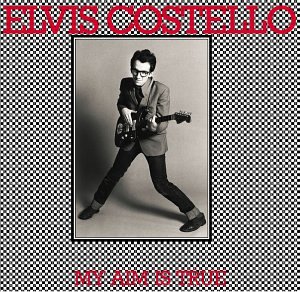
Album Assignments: My Aim Is True

Quoth Robby, last Monday:

Your new assignment for the week is…….
Elvis Costello’s brilliant album from 1977, “My Aim Is True.” I try not to editorialize when I introduce the albums so as not to bias anything, but I can’t help myself with this one. I love this album!

And he’s right, this is a brilliant album. For one thing, it’s just bursting with clever lyrics, starting from the very beginning: “Now that your picture’s in the paper being rhythmically admired…” has to be the best masturbation euphemism in rock. (A more crowded field than you might think — just ask Peter Green or Pete Townshend or Cyndi Lauper.) There’s plenty more, too. How about “I’ve tried and I’ve tried and I’m still mystified / I can’t do it anymore and I’m not satisfied” from “Mystery Dance”, or for that matter the entire song’s frustrated evocation of teenage naivete about sex? From “Alison”, “I don’t know if you’ve been loving some body / I only know it isn’t mine” is totally unforgettable. And of course, “I used to be disgusted / but now I try to be amused” is one of the greatest and most quotable lyrics ever.

There’s a Costello-shaped hole in my musical knowledge, due to a quirk of my history. I had a pretty negative experience (in certain ways) my freshman year of college, including a dismal roommate situation with a guy who LOOOOVED Elvis Costello and Squeeze. So for years I unfairly associated those two artists with misery and depression. Even now, they remain only greatest hits bands for me, and I’m very grateful to Robby for specifically prompting me to pay a little closer attention to this phenomenal debut. I was struck by how much it reminds me of one of my all-time favorite debuts, an album I’ve played hundreds of times: Joe Jackson’s Look Sharp!. Not only do these two albums have a point of view and musical attack in common, the artists are at least spiritual cousins, restless and prodigious composers who’ve had long careers of hopping from one style to another, mastering them all and frequently pairing them all with biting and/or poignant lyrics.

Jackson and Costello were labeled “angry young men”, to their mutual disgust, but there’s something to the label, at least for these early albums. So what is Costello angry about? Well, women, for one thing. In song after song, he spits venomous words about some girl or another. In “No Dancing”, “she has made a fool of him / like girls have done so many nights before / time and time again.” In “(The Angels Wanna Wear My) Red Shoes”, he says “I’m so happy I could die,” to which she replies, “Drop dead.” In “Miracle Man”, he sneers, “Everybody loves you so much girl / I just don’t know how you stand the strain.” His anger is most obvious, ironically, on the song “I’m Not Angry.” This is a classic emotion-denial song, right in line with 10cc’s “I’m Not In Love” and John Waite’s “Missing You” — the word “angry”, in a sinister whisper close to the mic, makes it obvious just how angry he really is, despite all protestations to the contrary.

Album cover of "My Aim Is True"

In fact, denying what he really feels (while at the same time completely revealing it) is the primary hallmark of this album. He seems to be angry at women, but look a little closer and it becomes pretty clear that what’s at stake here is injured male pride, vulnerable and badly hidden. Being made a fool of, being rejected, being a loser among competing suitors — every tenderhearted boy’s fear is right here, along with their blustering defenses. If you are or have ever been a boy who struggles with your own ego, emotions, and desires, this is the album for you, because it understands not only the pain, but how you cover it up. Costello has a tough-guy front going on in his punky singing style, and in his claims to be waiting for the end of the world. Everything means less than zero, he tells us, but the evidence is everywhere that everything means quite a bit more to him. He shows us noir femmes fatales in “Watching The Detectives”, their icy indifference highlighted in a shot-by-shot description of a tragic ending for some poor doomed sucker in love: “She’s filing her nails while they’re dragging the lake.” Those detectives, he says, can’t be wounded because they’ve got no hearts, but he knows the truth: they, and he, and everybody this album speaks to, are nothing but heart underneath.

It’s all there in “Sneaky Feelings”, where he nobly suppresses his desires for fear of “breakin’ up somebody else’s home.” It comes out more poetically in the album’s masterpiece, “Alison.” “I’m not gonna get too sentimental,” he claims, but moments later is achingly declaring, “I know this world is killing you.” She has a husband, but he sees her suffer, and can’t stand it. Calling up echoes of Etta James’ “I’d Rather Go Blind”, he wishes that somebody would “put out the big light / cause I can’t stand to see you this way.”

What he really wants her to know, though, what he says over and over so much that it sums up the whole album is: my aim is true. What does that mean? It’s an emotional authenticity, surely: “I speak the truth.” But look at all the cover-ups, all the misdirections, all the denials. I think Costello shows us an irony within that earnest declaration. “My aim is true,” claims the narrator of “Alison”, even as he contradicts himself, even has he teeters on the precipice of letting all those sneaky feelings show. “My aim is true” might mean, “I’m better for you than anyone else”, but that’s just male pride again, lining up once more to get shot down. I think what it really means, at bottom, is something pretty simple: my emotions are intense, I crave connection, I’m vulnerable, and I’m scared. In other words, the human condition in general, and the teens/twenties sensitive male condition in particular. Usually the best we can do is try to be amused.

Album Assignments: The Art Of McCartney [Disc 2]

Disc 2 of The Art Of McCartney, like Disc 1, is kind of a mixed bag. Last time the buckets were a little more thematic, but this time I am straight-up grading them. What I noticed this time around is that McCartney’s output has a wide range of quality, and some songs give the artist a lot more to live up to than others. I’m not assigning scores or anything, but “degree of difficulty” definitely played into my evaluations — if you start with a bad song and end up pretty good, it’s extra impressive, and if you start with a great song and sound bad, it is terrible. Let’s go in descending order of quality:

Covers That Transcend The Original

  • Smokey Robinson – So Bad — How does it happen that people like Bob Dylan and Billy Joel sound kind of wrecked, but Smokey Robinson still sounds perfect? Whatever it is, I’m not complaining, because he turns this somewhat obscure track from the Pipes Of Peace album into the sweetest song. It’s the kind of song he was born to sing, and while Paul’s falsetto on the original is impressive, it’s not a patch on this.
  • The Airborne Toxic Event – No More Lonely Nights — I know nothing at all about The Airborne Toxic Event, besides that they have a memorable name, but I was quite impressed with their treatment of this song. The original isn’t great — a typical mid-80s McCartney schmaltz-fest — but TATE turns in a delicate acoustic treatment, stripping out the showmanship and replacing it with yearning.
  • Toots Hibbert with Sly & Robbie – Come And Get It — Nothing against Badfinger, but when I heard this reggae version of “Come And Get It”, I felt like I understood the song for the first time. Of course it’s a reggae song.
  • B.B. King – On The Way — B.B. King pulls off a rare and remarkable trick here, which is that he makes his version sound like it’s supposed to be the original. When I listen to this track, it makes McCartney’s weird, experimental approach on McCartney II sound like the avant-garde cover of a straight-ahead B.B. King song.

Covers That Live Up To The Original

  • Heart – Letting Go — Again, there’s very little difference musically between this version and the original. (I think producer Ralph Sall actually had McCartney’s touring band play a lot of the backing tracks.) But Ann and Nancy bring a vocal power that really suits this song, enlivening it enough to stand toe-to-toe with the Venus And Mars original.
  • Allen Touissant – Lady Madonna — Two things elevate this version: Touissant’s piano, and the way he sings a countermelody instead of the familiar Beatles’ tune.
  • Sammy Hagar – Birthday — C’mon, what’s not fun about Sammy Hagar singing “Birthday”? I love all his little rock-n-roll yelps. “Yeah! Come on! Woo! Uh-huh! Dig it!” It’s a party tune, and the Red Rocker party treatment is perfect for it.
  • Robert Smith – C Moon — I really, really dislike “C Moon.” Just by not saying, “Was that the intro? I should’ve been in! Uh-buh-buh-buhhhh…!”, Smith already scored big points with me. I still don’t like the song, but pull out the dopey approach, children’s chorus, and otherwise lethal levels of twee, and you end up with a much more tolerable song. I guess what I’m saying is it was a pretty damn low bar, and Smith jumped over it.
  • Peter, Bjorn, and John – Put It There — I think Flowers In The Dirt was one of Sir Paul’s best post-Beatles efforts, and I was glad to see it represented in this collection. This cover shows that PB&J get what was special about the original, and are able to update it without losing its spirit.

Inside cover of The Art Of McCartney -- fake signatures (i.e. a handwriting font) from the participating artists

Covers That Don’t Improve Or Detract From The Original

  • Billy Joel – Live And Let Die — He’s still doing the Billy Joel Armstrong thing here, but there are two saving graces. First, he does it less. Second, this song is a lot better suited to that full-throated gravelly thing, because it’s already kind of a kooky, over-the-top song to begin with, rather than “Maybe I’m Amazed”, which is meant to be tender. Thus, we end up with a perfectly serviceable cover of “Live And Let Die.”
  • Chrissie Hynde – Let It Be — I agonized over this one. On the one hand, I love “Let It Be” and I love Chrissie Hynde’s voice, so on paper this should be a slam dunk. But because I love the original “Let It Be” so much, it’s tough for any cover to measure up. Plus, Chrissie does this weird thing in her vocal, where she Buddy Holly hiccups over a number of words, putting a distinct break into words like “in”, “right”, and “be”. “Be” just sounds weird as a two-syllable word, and it’s distracting. Still, other than that, she sounds great, and she delivers the right level of emotion. So I ended up kind of in the middle – parts of it I love, and parts of it I wish she’d made a different choice.
  • Robin Zander And Rick Nielsen – Jet — A very literal cover. Fun, like the original. In fact, pretty much overall just like the original.
  • Perry Farrell – Got to Get You Into My Life — I am a stone-cold, confirmed, Jane’s Addiction HATER. So I approached this one with dread. Imagine my surprise to find that very little of anything I associate musically with Perry Farrell appears here at all. For other combinations of artist and song, that would be a disappointment, but here it is a huge relief. I enjoy this version a lot, probably because it sounds so much like the original.

Covers That Aren’t Quite Good

  • Joe Elliott – Hi Hi Hi — “Hi Hi Hi” is better than “C Moon” (they were a double-A-sided single in 1972), but that doesn’t make it good. Joe Elliott gives it a completely bland treatment which doesn’t help it out.
  • Owl City – Listen To What The Man Said — Did “Listen To What The Man Said” really need more wide-eyed enthusiasm?
  • Dion – Drive My Car — It’s neat that Dion is still singing and releasing new music. A 50’s-style treatment of “Drive My Car” could have been fun. This is not that. It’s a pretty straightforward cover, done in an idiosyncratic voice. Not bad, but not quite good either.
  • Alice Cooper – Eleanor Rigby — There’s nothing particularly Alice Cooper-ish about this cover of “Eleanor Rigby”, which I guess is good? But on the other hand, it feels like any reasonably competent singer could have made this version, which is to say, it’s not very interesting or exciting. Check out Joe Jackson’s version for a much cooler cover of this song.

Covers That Are Just Bad

  • Dr. John – Let ‘Em In — I have never understood the appeal of Dr. John. I mean, obviously the guy has had a long career. I just watched him in The Last Waltz, from 1979, and here he is on an album from 2014. But to me, he’s like a comedian who only knows one joke, and the joke is only mildly funny. He does everything the exact same way. So, it turns out it’s possible to make a somewhat irritating song like “Let ‘Em In” actually SUPER ANNOYING if you bring a mannered enough approach to it.
  • Steve Miller – Hey Jude — Oh, god. This is, by a pretty wide margin, the worst cover to appear on either CD. Remember how I said Steve Miller was perfectly cast to sing “Junior’s Farm”? Well, the same cannot be said for frickin’ “Hey Jude”. Steve Miller is great to have a goofy good time with, but he’s not your guy for an uplifting spiritual experience. They sound like a tired frat party band, as the evening is winding down and just a few stragglers are chatting on couches and hoping to get lucky. If you’ve ever hoped to hear a version of “Hey Jude” that feels both lazy and desperate, have I got a cover for you, and believe me, you can have it.

Album Assignments: Brothers

My assignment this week was the album Brothers, by The Black Keys. So: the first thing I notice about Brothers is the blaring, harsh production on the vocals and some instruments. I know next to nothing about audio engineering and mastering, but to me it sounds like they deliberately spiked the input levels on those things so that the waveforms got clipped. Either that or they had a dial labeled “BLARE” on the console, and they turned that one all the way up. Either way, I found it an offputting sound, especially at first. I kept feeling like I was on the edge of the stage, for a band whose speakers had just blown out, but who couldn’t afford to get new ones.

It has to be intentional. There’s no way a sound like that happens by accident, not for the length of an entire album. So I got to thinking, what effect are they after? The distorted, fuzzed-out vocals have a sinister, eerie feel, keeping us at arm’s length while the deformed guitars howl with intensity. And it turns out this casts a peculiar shadow on the songs. Because I wasn’t allowed to hear a naturalistic tone, I couldn’t conflate the song with the singer. The sound created a kind of split consciousness, with the character narrating some feeling or story, and the wall of distortion either calling that story into question or shrouding it in heavy atmosphere.

Cover of Brothers

That works for these songs, because these are songs of desperation and dread. Take a song like “The Go Getter” — the lyrics alone are a dark portrait of an L.A. loser, very reminiscent of something that might have appeared on David & David’s Boomtown. But where David & David would have sung it without a filter, The Black Keys make its voice and bass sound broken. Under that layer, its darkness deepens.

Then, on the other side, listen to “Everlasting Light.” Lyrically, it is a straightfoward declaration of devotion. But the distortion is so heavy, the falsetto driven to such a frantic extreme, that I can’t hear it as a “silly love song.” It has a quality of intense neediness instead, an almost stalker-ish sense of wrong.

With that frame in mind, and once I’d gotten past my crotchety irritation at being denied anything that sounded like a pure voice, I came to really enjoy this album. Some favorites:

  • “Next Girl” – This was probably my favorite track on the album. It has such a satisfying, rocky stomp, and I love the lyrics too. Though I couldn’t help being reminded of something Lindsey Buckingham once said about his song “Never Going Back Again”: “That’s a very naive song. Never going back again? Sure. [laughs]”. Oh, your next girl will be nothing at all like your ex-girl? You’ll never make those mistakes again? Sure.
  • “I’m Not The One” – A more direct, less merciful update of Dylan’s “It Ain’t Me, Babe”
  • “These Days” – One of the least distorted vocals on the album, which makes me think it’s one of the most sincere songs. I love the sense of yearning, and the lyric “These blood red eyes / Don’t see so good / But what’s worse is if they could.”
  • “Tighten Up” – I can see why this one was the single. Many of the best songs on this album have either a great riff or a great groove, and this song has both.
  • “Too Afraid To Love You” – That harpsichord! What an unexpected sound, but somehow it works perfectly in this fear-drenched song.

So thanks for this assignment, Robby! Getting to know this album made me a fan of it.

Album Assignments: The Art Of McCartney [Disc 1]

This time it was my turn to give Robby an assignment, and I chose the first CD of a Paul McCartney tribute album released late last year. (You can probably guess what his second assignment will be.) Like many tribute albums, it was a pretty mixed bag. As I listened, I found the songs fell into a few different buckets for me:

Legends Who Have Ruined Their Voices

  • Billy Joel – Maybe I’m Amazed – On Billy Joel’s first album, he sounded like he wanted so badly to be Paul McCartney, and sometimes he came pretty close. Thus, the idea of him singing “Maybe I’m Amazed” seemed perfect to me, and for the first two lines, it is. Then he dips down into this gravelly Louis Armstrong impression (Billy Joel Armstrong, perhaps?) and rides it out for the rest of the song. I would have loved to hear Cold Spring Harbor Billy Joel sing “Maybe I’m Amazed”, but this one? Less so. It still makes me happy, but I wish he hadn’t waited so long.
  • Bob Dylan – Things We Said Today – On the other hand, the cup of gravel Billy Joel drank doesn’t come close to comparing with the five-gallon vat Bob Dylan seems to have consumed. I’m a big Dylan fan, but I found this just painful to listen to.
  • Roger Daltrey – Helter Skelter – “I’ve got blisters on my larynx!” Who megafan Trrish tells me that Roger gets nodules on his vocal cords, and periodically he has to get surgery to have them removed. Time to head back to the doc, Roger.
  • (To a lesser extent) Brian Wilson – Wanderlust – Not only has Wilson lived some pretty hard years, he also made music in his youth that was just made of youth. Tough setup for aging. He doesn’t (and can’t) sound the way he once did, but his version of this obscure song is rather lovely.

Stars Who Still Sound Fine, But Make No Difference

  • Heart – Band On The Run – Ann and Nancy still sound great. This song, however, like a lot of the songs on this disc, is faithful to the point of karaoke. So while it’s fun to hear their voice in place of Paul and Linda’s, there’s not much more to it than that.
  • Paul Rodgers – Let Me Roll It – Same deal here. It’s a novelty to hear Rodgers on this vocal, but otherwise it is an extremely straight reading of the song.
  • Corinne Bailey Rae – Bluebird – Rae sounds lovely on this track, but again, there doesn’t seem to be much interpretation involved.
  • Def Leppard – Helen Wheels – Maybe there was a rule that if you were covering something from Band On The Run, no alterations were allowed? I’m a fan of early Def Leppard (they lost me permanently at “Let’s Get Rocked”), but here they sound like they could be any bar band.

Cover image for The Art Of McCartney

Artists Who Bring Something Special

  • Steve Miller – Junior’s Farm – Steve Miller is a perfect choice for “Junior’s Farm”, because “Junior’s Farm” might as well be a Steve Miller song already. The poker man, the Eskimo, the sea lion, “he bought a gee-gee” — they fit in perfectly with the pompatus of love, the midnight toker, the crate of papayas, and Billy Mack, who knows exactly what the facts is. It’s not that he sings it any differently, it’s just that he’s so well cast.
  • Kiss – Venus And Mars/Rock Show – Just having Kiss do this song takes it out of the bouncy realm of the original. It’s also a fun idea to have Simmons do the initial, slow part, and then have Stanley come in on the more rockin’ part. Despite the fact that the tempo, instrumentation, etc. are identical to the original, the silliness of Kiss feels qualitatively different from the silliness of McCartney on the silly parts, and they bring a lot more rock crunch to the rockin’ parts.
  • Jamie Cullum – Every Night – I had never heard of Cullum before, but I think I need to find out more. I was already a big fan of this song, but Cullum’s reading of it is terrific, especially the jazzy vocal improvisation at the end.

Poignant Songs About Change

  • Yusuf/Cat Stevens – The Long And Winding Road – McCartney wrote many of these songs in his twenties, and yet some of them have this remarkable melancholy quality, wistful about the passage of time over years and decades. That feeling gets amplified when older artists sing these songs, especially artists who have gone through a lot of changes themselves. Yusuf’s voice doesn’t sound identical to the Cat Stevens days, but it evokes that young man in the 70s who had such a long and winding road ahead of him. “You left me standing here, a long long time ago,” he sings, but really, it’s he who left us. I never thought I’d hear that sweet voice sing a secular song again. It’s good to have him back.
  • Willie Nelson – Yesterday – I’ve never been a Willie Nelson fan at all, but his worn, weathered voice brings a new tone to this song, a sense of regret that goes well beyond the day before. I also appreciated that he was willing to bring different instrumentation to the backing track — the harmonica is perfect.
  • Jeff Lynne – Junk – This is a tremendously underrated McCartney song to begin with, and Lynne does a masterful job at bringing out its quiet sense of loss.

Covers That Are Just Bad

  • Barry Gibb – When I’m 64 – Paul is cute and charming enough to pull off even a song this twee. Barry Gibb commands no such sway, at least not over me.
  • The Cure feat. James McCartney – Hello Goodbye – Boy, I like The Cure a lot, but I sure do not like this cover. I mean, I’m glad Robert Smith isn’t so down anymore, but his vocal tone is a terrible match for this song, he doesn’t sound all that committed to it, and I can’t hear James McCartney at all, not that I know it would help if I could. Also, changing the chant at the end to “aloha”… just stop. Sounds like Smith has gotten some great antidepressants on board and spent some time in Hawaii, but he’s not doing us any favors here.
  • Harry Connick, Jr. – My Love – Ugh, the worst of the worst. Connick sounds like he’s half-asleep, and the awake part isn’t helping either. His career is based on being a second-rate Sinatra in the first place, but here he sounds like Rick Moranis imitating Perry Como. On the other hand, he sure picked the right song.

Album Assignments: Breakfast In America

This week, my friend Robby wrote me with a suggestion. “A weekly adventure,” he called it. The game is to take turns assigning each other an album to listen to, on a weekly basis, and on Monday he gave me my first assignment: Breakfast In America by Supertramp. I am up for this kind of fun, and I decided to go one better and write a little bit about the albums too, at least when the spirit moves me.

Breakfast In America was a really big album. Huge. But it was really big in 1979, a few years before I was really dialed into music. Consequently, my impressions of it from the time are glancing. I remember seeing a big display in a mall record store and thinking, “What’s with the lady and the tray? Is that orange juice?” Hey, I was 9. Anyway, once I was in high school I revisited the record, thanks to the public library, and came to really love it, and also to appreciate its fantastically clever cover. It’s also one of my favorite albums in the world to sing — I had such a great time this week rocking out to it. Anyway, I’ve been living with this album for many years, and know the songs pretty well, but it’s not one of those albums I know backwards and forwards. That comes into play in a moment.

See, I first tried listening via Spotify, but forgot that unless you pay Spotify some money every month, it throws commercials at you every 3 songs. Not a big bother when you’re listening to it like radio, but a major annoyance when you’re trying to appreciate an album. Then I remembered I have the album on my iPod, and was soon happily playing it in my car. But something seemed a little… off. I knew all the songs, but I must have misremembered the running order. I was composing paragraphs in my head about how peculiar it was to have “Take the Long Way Home” as the third song on the album, and how “Just Another Nervous Wreck” was a strange closer, and so on, until I finally realized (after a couple of times through, mind you) that my iPod was on shuffle mode. D’OH!

That experience led me to appreciate just how good the running order is on this album. Not something I normally notice, but it’s beautifully crafted. The long slow buildup of “Gone Hollywood” kicks off Side 1 (remember, this was put together when albums still had sides), matched by the long slow buildup of “Take The Long Way Home”, which opens side 2. “Gone Hollywood” has another companion piece, too — the album begins and ends with the only two songs co-written by the band’s two songwriters, Rick Davies (no relation to Ray or Dave) and Roger Hodgson. On the first side (after “Gone Hollywood”), Davies and Hodgson alternate songs, and on the second side they each get a pair of songs, before combining in “Child Of Vision”, which expresses itself as a conversation (or argument) between the two of them.

Album cover for Breakfast In America

About those two. Davies and Hodgson have very different voices, very different sensibilities, and they complement each other beautifully in this band. This time through, they were feeling like expressions of elemental Earth and Air to me. Davies is very rooted in the physical, its pleasures and hardships, and sings in an earthy baritone. Hodgson, on the other hand, is much more spiritual, and sings in a voice two steps from the angels. They’re both great songwriters, and the interplay between them sets up a tension that makes the songs and the overall album feel really dynamic.

In the end, I tend to gravitate towards Hodgson over Davies, though I do appreciate Davies, even if I’m not always sure what he’s up to. “Goodbye Stranger” seems like such a quintessential expression of silk-shirted, hairy-chested, medallion-wearing 1970s playboy masculinity that I can’t quite tell whether he’s parodying the character or embodying him. Most of the way through, he’s smoothly defending being a womanizing commitment-phobe, but there’s a moment, at about 4:30, when the whole thing feels like it drops off a cliff into an unsettling minor key, casting a shadow of doubt on every claim. Then the propulsive beat kicks back in, and a guitar solo streaks down the road, following the character to his next conquest.

Still, when it comes right down to it, for me, Breakfast In America is about two songs, both by Hodgson: “The Logical Song” and “Take The Long Way Home”. The opening chords of “Take The Long Way Home” create a portentous mood, like a heavy cloud, and then the purest, sweetest harmonica pierces them, like a shaft of bright sunlight, buoyed by joyful piano. It gives me chills. It’s perfect. The words to the song reflect that contrast too. It’s a feeling of disconnection I think we all experience — one part of your life can feel so good, so affirming, so uplifting, and then just like that, you run into someone who has a very different view. All of a sudden, their doubt exposes your own, and it all seems hollow. What’s the answer? Take the long way home. To me, it means finding a place in yourself, by yourself, where you know what’s true, how you can be satisfied. You’re not always there, but you point yourself in that direction. That’s how you get home.

“The Logical Song” talks about a different kind of disconnection. For me it evokes the last chapter of The House At Pooh Corner, which I’ve written about before. That transition point of leaving pure childhood behind, entering into a world that requires you to be “sensible, logical, responsible, practical,” has an unbelievably piercing poignancy to me. It is a deep, deep feeling, and I don’t think I can ever write about it again as well as I wrote about it in that blog entry, so I’m not going to try. All I can say is that Hodgson nails it, and I feel it every time, and it is the sweetest ache. That song is about as good as songs get. Watching Dante go off to school again this week, I feel it all over again. When we cry out at night, needing desperately to figure out who we are, songs like this let us know we’re not alone.

Page 9 of 9

Powered by WordPress & Theme by Anders Norén