Paul O'Brian writes about Watchmen, trivia, albums, interactive fiction, and more.

>SUPERVERBOSE

Tag: movies Page 2 of 5

The Watchmen Bestiary 25 – Whose Mind Is Pure Machinery

First things first: this project has a new name. I was never entirely satisfied with The Annotated Annotated Watchmen as a project title. Not only is it an awkward mouthful, it’s factually inaccurate. I’m writing essays, not annotations. But The Essayed Watchmen never really did it for me either.

For many an entry have I fretted about this, but I just could not find an alternate title that spoke to me loudly and clearly enough. For this 25th post, though, I resolved to redouble my efforts, and in a reread of Chapter 1 noticed this panel:

Chapter 1, page 23, panel 7 of Watchmen. Dr. Manhattan is manipulating machinery and says, "I think I'm close to locating a gluino, which would completely validate supersymmetrical theory if we could include it in the bestiary."

The bestiary! In Watchmen, the bestiary seems to be two things. First, it’s a collection of items that underpin the universe, which Dr. Manhattan examines in order to better understand the workings of that universe. So far, so perfect — that’s exactly what these essays are working to do, one exotic and breathtaking specimen at a time. The other Bestiary in Watchmen is “where the real heavy-duty thinkin’ gets done” by the Gila Flats crew in Jon Osterman’s early days as a physicist. It’s the on-base bar where the various residents find themselves “at play amidst the strangeness and charm.”

That meaning works perfectly for me too, because these essays are my way of extending the tremendous strangeness and charm that Watchmen exerts over me and millions of other readers. And doing so is just plain fun for me, which is why I keep doing it. It sure isn’t for the money or fame.

Therefore, I proudly present The Watchmen Bestiary, a rechristening of my ongoing Watchmen project. As a part of this change, I’ve gone back in and renamed all the old entries, and in some cases done some light editing and updating of them. If anyone happens across anything screwed up as a result of this, please let me know.

And now, on with today’s entry. Please note that, as always, there are Watchmen spoilers in this post. I also discuss the plot of Fritz Lang’s 1927 film Metropolis.

Most of these essays focus on a single work, or at least the works of a single artist or author. Today’s entry, though, focuses on a name. It’s a name that spans many works, many authors. A name that echoes through millennia. Moloch.

Chapter 2, page 21, panel 2 of Watchmen. Rorschach has Moloch pinned to the ground, and says, "No. Edgar William Jacobi, also known as Edgar William Vaughn, also known as William Edgar Bright, also known as Moloch."

Here’s what Chapter 2 of the web annotations has to say about him:

Moloch, an ancient god who became a demon in Christian cosmology, is also the name given to the giant machine with a giant dial operated by the oppressed workers in Fritz Lang’s film “Metropolis”.

The annotations are quite right to cite the Bible and Metropolis, as both were pretty clearly influences on Moore. He references the Bible throughout Watchmen — the Pale Horse reference to Revelation is just the first of many.

The Metropolis connection is a bit more tenuous, but apart from being able to count on Moore’s general erudition, there’s also the fact that both Metropolis and Lang’s recurring character Dr. Mabuse feature prominently in the League Of Extraordinary Gentlemen story Nemo: The Roses Of Berlin. Granted, that book came out much later than Watchmen, but let’s also remember that in 1984, music producer Giorgio Moroder restored and re-released Lang’s film in theaters, with a pop music soundtrack. Between the fact that the pop Metropolis was roughly contemporary during the writing of Watchmen, and Moore’s later demonstrated connection to the material, I’m comfortable asserting that Metropolis would have been in Moore’s constellation of references when he chose to name a character Moloch.

Also in that constellation are the writers of the Beat movement. We’ve already seen how strong an influence William Burroughs had on Watchmen, but it turns out he wasn’t the only Beat with a connection. As it happens, Allen Ginsberg’s most famous poem, “Howl”, repeats the word “Moloch” 39 times in the 383 words of its second section, employing imagery that was clearly influenced by Lang. There are plenty of other writers who incorporate Moloch — Milton and Flaubert are a couple of the biggies — but it’s the Bible, Metropolis, and “Howl” that seem most connected with Moore’s repertoire, so let’s focus on them.

Moloch The Abomination

In the Bible, Moloch or Molech (both spellings appear in the King James Version) seems to derive from the Hebrew word melech, meaning “king”, combined with the vowels from the word for “shame” to give it a pejorative flavor. The implication is of a “Lord” (or god) whose worshipers should be ashamed.

Most of the mentions of Moloch occur in Leviticus, a book concerned with setting out rules for the Israelites. A typical mention, as translated in the KJV: “And thou shalt not let any of thy seed pass through the fire to Molech, neither shalt thou profane the name of thy god: I am the LORD.” (Lev 18:21) This diction may obscure just what’s being forbidden, but the English Standard Version is as usual more straightforward: “You shall not give any of your children to offer them to Molech, and so profane the name of your God: I am the LORD.” In 1 Kings he is called an “abomination”, and we see Solomon seduced into worshiping him. (1 Kings 11:7)

So it would appear that Moloch is a rival god to Yahweh, and that Moloch’s distinguishing feature is his demand that followers sacrifice their children to him, likely by ritual burning if the oft-repeated phrase “pass through the fire” has any literal meaning at all. In fact, a couple of 19th-century German scholars offered the radical argument that the cult of Yahweh in fact grew out of the cult of Moloch, differentiating itself by its rejection of human sacrifice. Other critics saw anti-Semitism in this premise, an attempt to slander Jews by suggesting that the “orthodox” version of Judaism was entwined in blood rituals. For our purposes, what matters is that the Biblical Moloch is synonymous with human sacrifice, in particular the sacrifice of children, and that this practice sets him apart from Yahweh.

18th-century depiction of Moloch as a statue with chambers for burning.

What does this idea of human sacrifice have to do with Watchmen‘s Moloch? Very little, I would argue. Edgar Jacobi, aka Moloch, who Hollis Mason describes as “an ingenious and flamboyant criminal mastermind” in his heyday, seems to be Watchmen‘s canonical example of the “schmuck in a Halloween suit” that the Comedian derides in one of this chapter’s flashbacks. He’s non-threatening enough that Veidt’s marketing department eventually wants to make an action figure out of him.

There is almost no hint of human sacrifice, nor indeed any kind of murder, in what we know about him. He initially styles himself as a stage magician, and tends to sport a tuxedo in the flashbacks to his active days. In Chapter 4 we see him with a spooky skull necklace, but that’s about as close as he gets to courting death. He appropriates the name (and perhaps the pointy ears?) of a demon-god, but does nothing very demonic or godlike, moving into organized crime in the 1940s before finally spending the Seventies in jail.

So why the name Moloch? What does the concept of Moloch have to do with anything in Watchmen? Well, the actual Edgar Jacobi may be a red herring, the literal example of false danger that The Comedian cites in the Crimebusters meeting, but there is indeed a figure who embodies all that Moloch represents: Ozymandias. Adrian Veidt fancies himself somewhere between a king and a god. In the Bible, the difference between good god Yahweh and wicked god Moloch is whether that god is willing to sacrifice its own. Yahweh doesn’t demand the killing of anyone’s children. (Well, except for that one time, and it turns out He was faking it.) Ozymandias, though, creates an entire plan predicated on human sacrifice, and not just any humans, but the very New Yorkers whom he protected in his days as a costumed hero.

Even before the book’s climactic slaughter, Adrian is methodically killing people all over the place. He blows up the boat containing all the writers, artists, and scientists he bribed and tricked into his scheme. He eliminates every underworld figure who could be traced back to Pyramid Deliveries. He irradiates Dr. Manhattan’s associates to give them cancer, thus making Watchmen‘s Moloch the subject rather than the object of sacrifice. All in the service of his vision.

When comparing Watchmen to the book of Revelation, we saw how much Moore and Gibbons’ story was an inversion of the Biblical apocalypse, from its disruption of the good/evil binary to its reversal of the typical combat myth. In Ozymandias, we see yet another Biblical reversal — rather than Yahweh’s rejection of child sacrifice, Ozymandias turns into the kind of god who embraces it. The closest thing to a child character in the book — Bernard the younger — dies in the arms of his elder namesake when Veidt’s squid creature arrives.

The Moloch Machine

Adrian also has a few things in common with Joh Fredersen, the master of the title Metropolis in Fritz Lang’s film. Both men are masters of a business empire, who have attendants hanging on their every word to carry out their orders. Where Veidt built the Antarctic refuge of Karnak and its fantastical vivarium, Fredersen created the “Stadium Of The Sons”, in which the male offspring of Metropolis’s 1% frolic among freely available plants, fountains, and women. Where Veidt registered the patent for spark hydrants thanks to possibilities opened up by Dr. Manhattan, Fredersen creates a dazzling city thanks to the inventions of archetypal mad scientist Carl Rotwang. And where Nite Owl and Rorschach uncover the horrific human cost that Veidt is willing to incur in order to realize his dream, in Metropolis it’s Joh’s son Freder who makes the sickening discovery.

One day, as Freder is having his usual grand time in the Stadium Of The Sons, his merriment is interrupted by a working-class woman named Maria, who has taken a group of children up to the stadium to see how the upper crust lives. He becomes obsessed with Maria, and tries to follow her down to the underside of Metropolis, where workers endure endless toil to keep all the city’s machines operating. As viewers, we’ve already witnessed scenes of exhausted workers trooping through the undercity, their lives ruled by an omnipresent clock — another symbol in common between Metropolis and Watchmen.

When Freder enters the undercity, one of the first sights he encounters is an enormous machine, with rows of workers pulling levers in steady rhythm to keep its mysterious energies flowing. As Freder watches in alarm, one enervated worker struggles to do his part, but falls short, and the mechanism’s temperature rises. Finally, the thermometer reaches a critical level, and an explosion rocks the machine, sending workers flying through the air. At this moment, Freder has a vision of the machine as a huge, terrifying demon that consumes workers alive. Shaved and chained, they trudge up the stairs to be thrown into the fires within its gaping mouth. Overcome by the vision, Freder shouts out one word: “MOLOCH!”

Side-by-side screen captures from Metropolis, first of the machine as it is, second the way Freder sees it in his vision.

There’s not much ambiguity about the symbolic weight of this Moloch machine, nor in fact most of Metropolis, which takes its cue from the novel of the same name written by Lang’s then-wife Thea Von Harbou. The film announces in its first title card, “The mediator between brain and hands must be the heart!”, and then goes on to make it clear that the brain is capital (i.e. Joh) and the hands are the proletariat (i.e. those devoured by the Moloch machine.) In Joh Fredersen’s Metropolis, the price of that beautiful stadium, and the debauched club Yoshiwara, and all the other amazing conveyances and edifices and inventions, is human sacrifice. Working class people struggle and die to keep the machines fed, and when those machines go explosively wrong, the ruling class sees it as an impersonal correction, just one of those things.

When it seems like the “hands” might revolt, under the leadership of Maria, Fredersen and Rotwang disguise an android with her appearance, so as to disrupt the rebellion by discrediting its figurehead. Disaster ensues, culminating in a rooftop swordfight between Rotwang and Freder, who finally triumphs, killing the mad scientist. The film’s rather naive ending solves the problem of the city’s cruel machinery when Freder (as the mediating heart) joins the hands of capitalist Fredersen and lead worker Grot.

Ozymandias, too, builds an enormous machine to fuel his fondest dreams, but in his case the machine isn’t made of dials and levers and gears. It’s made of plans, and it consumes people for its purposes with no mediating heart in sight. Like the machines of Metropolis, it also reaches deep under the surface. According to this chapter, Veidt formed his intention in 1966 to solve the problem of inevitable nuclear war. According to Doug Roth in Chapter 4, Wally Weaver died of cancer in 1971. That means that Veidt’s plan was in motion within at least 5 years of that Crimebusters meeting, and that its turning gears had claimed their first life by then. In the ensuing 14 years, it finally realizes its destiny as “a lethal pyramid”, killing everyone involved, excepting some but not all of our main characters. After the hordes of corpses in chapter 12, Rorschach is the final slave to be marched into the gaping maw of Adrian’s Moloch machine.

It isn’t just planning, though. Veidt also relies upon a remarkable technology stack to create his “practical joke,” one even more farfetched than the androids and mega-machines of Metropolis. He kills his servants by elaborately staging their “deaths from exposure, after drunkenly opening [his] vivarium.” Like much of Metropolis, it makes for a hell of a visual, but falters under a bit of scrutiny — why would a tropical vivarium in Antarctica ever need to open in such a way, anyway? When Dan expresses skepticism that Adrian is even capable of killing half of New York, Veidt calmly explains that he cloned the brain of a psychic named Robert Deschaines into a “resonator”, with “terrible information” coded into it. Then, when its host creature dies, this mega-psychic brain somehow broadcasts “the signal triggered by the onset of death”, and that signal somehow kills 3 million people from “the shock”.

I think of Watchmen as a realistically grounded superhero narrative, maybe the most realistic one ever at the time of its publication. If you can accept the notion of Dr. Manhattan and how his existence would change the world, the rest plays out logically with no further recourse to the supernatural, right? Well, wrong. Because as wide-ranging as Dr. Manhattan’s powers and effects may be, they don’t reasonably explain the presence of psychic abilities in human beings. Veidt gestures to advancements in eugenics as Laurie fawns over Bubastis in Chapter 4, but telepathy is another story. Because Watchmen drapes itself in superhero tropes, it’s easy to overlook, but for Veidt’s plan to work, we must accept not only the implications of Dr. Manhattan, but the entirely separate implications of people who can project their thoughts.

Besides sharing in its implausibility, Ozymandias also echoes Metropolis by wielding super-scientific advancements as a murder weapon against anyone opposing his utopia. Despite his Egyptian iconography, Adrian Veidt is a technologist who achieves his victories through a combination of commerce and machines, using flesh draped on a bomb like the false Maria in Metropolis.

Moloch Whose Fingers Are Ten Armies

Cover of Howl by Allen Ginsberg. It reads "Howl and other poems. Allen Ginsberg. Introduction by William Carlos Williams." The top banner reads "The Pocket Poets Series" and the footer reads "Number Four." In Lang’s Metropolis, the Moloch machine consumes hordes of anonymous workers. In “Howl”, Allen Ginsberg ups the ante. His Moloch destroys “the best minds of my generation.” His Moloch is a “sphinx of aluminum and cement” that “bashed open their skulls and ate up their brains and imagination.” In other words, Ginsberg’s Moloch of industrialization doesn’t just destroy the working class hands, but also the open hearts that might have tried to serve as mediators.

He invokes “Moloch” like a chant in section II of the poem, and some of the imagery recalls Metropolis pretty clearly:

Moloch whose mind is pure machinery! Moloch whose blood is running money! Moloch whose fingers are ten armies! Moloch whose breast is a cannibal dynamo! Moloch whose ear is a smoking tomb!
Moloch whose eyes are a thousand blind windows! Moloch whose skyscrapers stand in the long streets like endless Jehovahs! Moloch whose factories dream and croak in the fog! Moloch whose smoke-stacks and antennae crown the cities!

The second quoted stanza clearly identifies various parts of the city as Moloch, and a Metropolis-like city it is, with skyscrapers, factories, smokestacks, and antennae. The anthropomorphization of buildings and tombs into body parts of the monster strongly echoes the way that the panels, apertures, and pipes of the Metropolis machine become eyes, mouth, and claws in Freder’s vision of Moloch. And of course the “cannibal dynamo” of its breast is pretty much a straight description of what happens in the Metropolis Moloch scene.

There may be another allusion to Lang here as well. One of the director’s trademarks was having a shot of a hand in each of his films, one way or another. Rotwang has an artificial hand that gets some attention, but there’s another sort of hand shot in the movie as well. There’s a sequence where Maria tells an allegorical story about building a “Tower of Babel”, another example of planning brains heartlessly directing working “hands”, and one famous shot from that sequence is of five columns of workers converging into a foreground of shave-pated men sullenly trudging forward.

The "workers hand" shot from Metropolis as described in the essay text.

As Tom Gunning points out in The Films Of Fritz Lang: Allegories of Vision and Modernity, the shot strongly suggests a hand. “The shape itself acts as a trope, based on the synecdoche introduced in Harbou’s text, the workers as ‘hands.’ We see the converging columns as the outspread fingers and the circular insert as a palm. The composition of roiling bodies also functions as a symbolic close-up of a hand, one of Lang’s most powerful visual tropes.” Separate regiments of workers coalesce into one central force. Or, if you’re Allen Ginsberg, “Moloch whose fingers are ten armies!”

So if the Biblical Moloch demands human sacrifices, like Adrian, and the Metropolis Moloch uses humans as fuel, like Adrian’s plan, what does Ginsberg’s work add to our understanding? Simply this: that those sacrifices aren’t just anonymous workers or unnamed children, but characters we come to know and care about through the course of the story. In section I of “Howl,” Ginsberg introduces us to a litany of behaviors and characters who embody them. Most of these are of the heroic-romantic nature, albeit from a bohemian point of view, fugitives from mass culture who bravely maintained intellectual independence and created unfettered works. They are all destroyed, and it is Moloch who destroys them.

In Watchmen, we come to know some of the “ordinary” people who get killed on November 2, 1985. There’s Bernard the newsstand vendor and Bernard the young reader, who we hear from throughout the book. There’s Malcolm Long and his wife Gloria, stars of Chapter 6. There’s Joey and her girlfriend, who we see in the throes of painful relationship dissolution. There’s Detective Steve Fine and his partner Joe, who open Chapter 1 and continue to investigate crimes on the fringes throughout the story. Ozymandias is the Moloch to whom all these victims are sacrificed, to appease his thirst for surreptitious control of the world’s nations.

That day is the final step in Adrian’s homicidal plan, and a trail of death leads up to it. There’s the island full of artists, writers, and scientists — Max Shea, Hira Manish, James Trafford March, Linette Paley, Norman Leith, Dr. Whittaker Furnesse. The best minds of their generation, destroyed in Veidt’s madness. Not to mention the literal “best mind”, Robert Deschaines, who apparently was more than a “so-called psychic and clairvoyant.” And Wally Weaver, and Janey Slater, and poor Edgar Jacobi himself, all marched into the maw of Ozymandias’ Moloch machinations, feeding their energies into its terrible purpose.

The sad, cancerous old man pinned to the ground by Rorschach did none of these things. In fact, he was just another victim of them. Jacobi pleads, “I’m not Moloch anymore,” and he’s right. The new Moloch is Ozymandias himself, whose mind is pure machinery.

Next Entry: Tears Of A Clown
Previous Entry: How The Ghost Of You Clings

The Watchmen Bestiary 18 – A Real Rain

Hey, you. Yes, I’m talkin’ to you, because I want you to know that there are spoilers in here, both for Watchmen and for Martin Scorsese’s 1976 film Taxi Driver. We’re talkin’ about Taxi Driver today because of one cjb@ice.physics.salford.ac.uk, who turns out to be named Christian Burnham. Burnham contributed to the v2.0 Watchmen Annotations, those annotations being a crowdsourced effort built atop Doug Atkinson’s original work. Burnham was the one who asserted way back in my first installment that “Edward Blake is obviously a reference to Blake Edwards,” and that “Rorschach’s methods of terrorism are all taken from Pink Panther movies.”

This time around, he claims that “Rorschach’s opener on page 1 issue 1 is a dead ringer for the dialogue of Travis Bickle in the film Taxi Driver.” Burnham has a tendency to overstate the case, and this time is no exception. While it’s true that both Rorschach and Bickle (Robert De Niro) keep a diary, and that their diary entries are provided in “voiceover” to give us insight into their minds, I wouldn’t call one a “dead ringer” for the other. There are definitely similarities, but also some important differences. Let’s compare styles.

Rorschach: “Dog carcass in alley this morning, tire tread on burst stomach. This city is afraid of me. I have seen its true face. The streets are extended gutters and the gutters are full of blood and when the drains finally scab over, all the vermin will drown. The accumulated filth of all their sex and murder will foam up about their waists and all the whores and politicians will look up and shout ‘Save us!’… and I’ll look down and whisper ‘No.'”

Bickle: “All the animals come out at night – whores, skunk pussies, buggers, queens, fairies, dopers, junkies. Sick, venal. Someday a real rain’ll come and wash all this scum off the streets. I go all over. I take people to the Bronx, Brooklyn, I take ’em to Harlem. I don’t care. Don’t make no difference to me. It does to some. Some won’t even take spooks. Don’t make no difference to me.”

Both these excerpts begin with shocking language and images. Both indicate a loathing and revulsion for the urban environment. But Rorschach’s opening sentence imitates his speech patterns — clipped sentence fragments, with articles and pronouns extracted, an almost Tonto-ish way of talking. Moore in fact uses this pattern as a tool later on to indicate the psychological split between when Walter Kovacs simply wore a mask and when he became Rorschach, as well as the psychological shift in Malcolm Long.

Interestingly, the rest of the excerpt (and most of Rorschach’s diary) is much more discursive than his usual speech. He spins grandiose, almost biblical images, like this one in which he stands as the vengeful god to punish human sins. Elsewhere, he documents the city as he sees it, or takes notes on the murder case. He even tells a joke.

First 3 panels of Watchmen, with Rorschach's dialogue as quoted above. All three panels are overhead shots, with the camera gradually pulling upward to reveal more.

Travis, on the other hand, is much more prosaic and down-to-earth. He talks about what happens in his job, how much he makes, and recounts details like “I had black coffee and apple pie with a slice of melted yellow cheese.” His diction is slangy and vernacular (not to mention casually racist and homophobic), where Rorschach tends toward theatrical, elevated words. Travis would never say something like, “This city is afraid of me. I have seen its true face.” When his diary entries become introspective, they tend to be vulnerable and searching, as opposed to Rorschach’s judgmental pronouncements. Travis reviles the city, sure, but he also explicitly laments his loneliness, something Rorschach only barely approaches when he asks (without a trace of irony), “Why are so few of us left active, healthy, and without personality disorders?”

However, just because Rorschach’s journal isn’t a “dead ringer” for Travis’s diary doesn’t mean that the comparison between Watchmen and Taxi Driver is pointless. On the contrary, I think it’s a very useful juxtaposition, one which illuminates them both.

THE NEW NOIR

Taxi Driver gets called a neo-noir film, a term which more or less means “a whole lot like film noir but made after 1958.” (See Hirsch and Schwartz, for example.) The notion of film noir itself has never enjoyed a stable, consensus definition, and in fact there is still contention over, for instance, whether it’s a style or a genre. But like Supreme Court Justice Potter Stewart’s relationship to pornography, critics know it when they see it.

Here are some film noir commonplaces:

  • A mood of pessimism, cynicism, and/or fatalism
  • Night scenes, especially night scenes in a city
  • Rain. Lots and lots of rain.
  • Also lots of smoke and smoking
  • Femmes fatales. As Roger Ebert puts it, “Women who would just as soon kill you as love you, and vice versa.”
  • An ordinary person drawn into crime, often based on some relationship with a femme fatale
  • A grim investigator unraveling a crime, an investigation which often reveals deep corruption
  • Odd or askew camera angles
  • Shadowy or high-contrast visual composition
  • Flashbacks, particularly telling the bulk of the movie in flashback, introduced by a frame story
  • First-person voiceover narration

A movie doesn’t have to have all of these to be considered noir, but the more of them that occur in one movie, the more noir it becomes. Once I started thinking about Taxi Driver as a noir movie, it became blindingly obvious to me that Watchmen is a noir comic book, or at the very least that Rorschach is a noir character, right down to his 1940s trenchcoat and fedora. While his narration differs from that of Travis, the presence of their narration serves the same set of functions. It sets the grim tenor of the story but makes it clear that the mood is filtered through one character’s mind, and that this character is himself unreliable and twisted in certain aspects.

The juxtaposition of narration and images allows us sometimes to see the story’s world as the character sees it, and other times to understand through ironic contrast where the character’s perceptions are limited, or where he may be lying to himself or others. And as both Taxi Driver and Watchmen postdate the classic film noir period, they are fully aware of noir conventions and use voiceover as a kind of combination homage and allegiance.

They have plenty in common with the noir sensibility besides the voiceover, too. Both have an overall sinister tone, and both end with a psychopathic character unexpectedly cast in a heroic light. Both stalk the rainy night city, Travis in his cab and Rorschach on foot. Smoke, too, figures into each story in different ways. None of the characters in Taxi Driver smoke, but mist and steam emanates from the streets themselves — the first several shots in the film include a taxi emerging from a cloud of smoke (along with the title itself), and that same smoke following Travis as he walks into the cab service to apply for a job.

Lots of characters smoke in Watchmen. In just the first two chapters, we see Detective Fine, Hollis Mason, various criminals, restaurant patrons, Laurie Juspeczyk, and Eddie Blake smoking various types of cigarettes or cigars. In addition to his stogie, Blake also shoots riot gas to smoke up the streets, and makes Captain Metropolis’ map go up in smoke as well. However, the smokiest thing about the book is easily Rorschach’s dialogue balloons. The character is never seen with a cigarette, but every time he talks or thinks, the edges of his words crinkle and curl, an ever-present noir vapor.

Shot from Taxi Driver with title emerging from smoke, next to panel from Watchmen showing Rorschach's smoky dialogue balloon

Femmes fatales, on the other hand, are noticeably missing from both works. I’ve already discussed the role of women overall in Watchmen: they mainly exist to demonstrate or alter male emotional states. That is somewhat true for the classic femme fatale as well, but in Watchmen the women are more victims than masterminds. No woman is calling the shots on anything in that story, but rather stumbling or being thrown from one mishap to another. Even Janey Slater, clearly embittered and smoking up a storm, turns out to have been Adrian’s pawn in her takedown of Dr. Manhattan.

Women in Taxi Driver are filtered through Travis’s consciousness, which will only allow for two categories: virgin and whore. He can hardly bear either one. He idolizes what he sees as the purity and elevation of Betsy (Cybill Shepherd), and even manages to take her out on a date, only to make the site of their date a porno theater, as if he must taint that purity and expose the taintedness of his own inner self. Then he fixates upon a different mix of virgin and whore: the twelve-year-old prostitute Iris (Jodie Foster). Where he wanted to sully Betsy’s innocence, he wants to restore Iris’s, trying to convince her to go back home, and sending her $500 to help her leave her pimp Sport (Harvey Keitel). In neither case does he engage with the woman in question as a person, but rather interacts almost exclusively with his projections of them.

No, it isn’t a femme fatale who draws Travis into mass murder. Rather, it is his utter inability to connect with other human beings. Whether this disconnection is an aftereffect of service in Vietnam, or whether it is inherent to Travis himself, the film doesn’t make clear. However, his “loneliness has followed me all my life” voiceover suggests that while Vietnam may have stoked his inclination to violence, Travis’s fundamental alienation is his own.

De Niro does a masterful job of building upon screenwriter Paul Schrader’s script to demonstrate Travis’s utter lack of facility with simple personal interactions. He’s baffled by simple expressions like “moonlighting” or “how’s it hangin’?”. He’s culturally isolated — at various points he says he doesn’t know much about movies, much about music. He watches his television periodically, with a look of longing and confusion on his face; eventually he pushes that TV off its stand, destroying it. In a knowing twist on noir convention, Travis tries to kill the father figures of his various women, not at their urging, but as a sort of revenge for the relationships they have, which he is forever denied.

Watchmen takes the other noir plot — not the common man corrupted but the cynical detective whose astute investigations soon land him in trouble beyond his capacity to deal with. Moore begins the story as a standard murder mystery, and in fact for a moment we believe we might be following the police investigation of Eddie Blake’s death. Soon enough we are following Rorschach, but even then, the pattern of introducing a series of characters and providing background on the deceased is a familiar one to mystery readers. Watchmen turns out to have a lot more on its mind than just solving a crime, but at least from Rorschach’s point of view, his trajectory is not all that different from that of the classic Phillip Marlowe or J.J. Gittes type, the private eye whose own investigation devastates and undoes him.

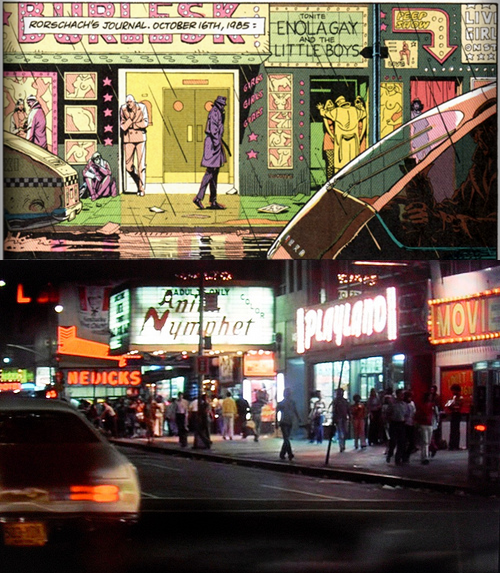
As for visual style, both Watchmen and Taxi Driver employ enough shadows and unsettling angles to easily qualify as neo-noir. Taxi Driver gives us shots of Travis’s eyes in the rear-view mirror, framed by blackness. It shows us fetishized close-ups of the taxi itself, driving through the rain, with garish Times Square movie marquees and porn store signs in the background. There’s a motif of high-angle shots straight down on a tableau – the personnel officer’s desk, the porn theater counter, the gun suitcase, Betsy’s desk. These culminate in a magnificent high-angle shot of the mass murder scene, moving slowly past the heads of stunned policemen, down the hallway and out into the street.

High angle shot from Taxi Driver of the murder scene

That same high angle appears in Watchmen‘s very first set of panels, the ones with the narration that started us down this road. The camera looks down at the bloodstained street, gradually pulling up, up, up to the site of Blake’s defenestration. Weird camera angles and shadowy composition abound especially (and not surprisingly) in the portions of Watchmen focused on Rorschach.

In Chapter 5, “Fearful Symmetry”, we get a recurring shot of the Rumrunner’s neon sign, reflected in a puddle, disturbed by Rorschach’s footstep. It’s a perfect noir shot, encompassing rain, darkness, the sinister city, and a sense of foreboding and destruction. Rorschach’s mask itself is the ultimate in high-contrast, its shadows always moving across his face. This effect is played up in “The Abyss Gazes Also”, whose penultimate panel is in fact nothing but blackness.

Finally, there are the flashbacks. Taxi Driver has none — it refuses to explain Travis by exploring his past, and it almost exclusively sticks to his point of view, denying us the capacity of understanding his world beyond his perception of it. Watchmen, on the other hand, is flashback-crazy. Whole chapters take us into the backstory of various characters, and previous chapters get called back by later chapters. Even single panels sometimes quickly throw us back to the past before returning to the scene at hand. Both, in their way, subvert the traditional noir mode of a frame story taking us into the past, either by sticking zenlike in the present or jumping around through time all the time.

Still, while neither Watchmen nor Taxi Driver ticks every box on the film noir checklist, there is more than enough evidence to call them both noir stories. But there’s something more: they’re also both superhero stories.

THE URBAN VIGILANTE

There are many ways to interpret the plot of Taxi Driver. Here’s one. An ordinary man, Travis Bickle, takes a blue-collar job after returning from war. This job brings him in contact with the worst parts of New York City. He sees firsthand the violence, the constant menace, the routine attacks upon innocent people, including attacks upon Travis himself. He witnesses the sleaze and degradation occurring in the city at night, and it becomes clear to him that the establishment police and politicians are fundamentally unable to stem its tide. He even connects with a heartbreaking victim of the city’s evil: a twelve-year-old girl named Iris, forced into prostitution by a pimp named Sport. That pimp pays Travis $20 to look the other way.

This $20 bill becomes a totem to Travis. He carries it with him, plagued by his guilt about not saving Iris from her dangerous situation. Finally, he makes up his mind to make a difference. “The idea had been growing in my brain for some time,” he writes in his diary. “True force.” He embarks on an intense regimen of physical training, honing his body until every muscle is tight, and he is nearly impervious to pain. He purchases an arsenal of weaponry, and rigs up ways to attach those weapons to his body, deploying them quickly when needed. He puts together a uniform which allows him to conceal the equipment he carries. “Here is a man who would not take it anymore,” he writes.

Shot from Taxi Driver of the device Travis rigs up to hide a gun in his sleeve and slide it out when he wants to use it.

He uses the $20 bill to pay for Iris’ time, in a failed attempt to get her to leave Sport of her own volition. But he finally realizes: he is the one who must rescue her, and save the innocence of the city itself. He creates a new persona and guise, one which will strike fear into the hearts of those he hunts. At first, he tries to bring down the corrupt system by targeting a political demagogue, but he soon realizes that he must go into the underworld directly. Armed with his equipment and his frightening appearance, he defeats Sport and two of Sport’s henchmen. He returns Iris to her parents, and is hailed by them and by the media in general as a hero. Some time later, he has returned to his job in his ordinary identity, but we know that he is ready to confront evil again, whenever he encounters it.

Sounds an awful lot like a superhero origin story, doesn’t it? In a certain light, Travis doesn’t look so different from Bruce Wayne, or Tony Stark, or Frank Castle: men without superhuman powers, but who nonetheless deploy muscles, weapons, and a frightening appearance to fight the crime in their societies. For that matter, he’s even closer to a character like Rorschach, who shares all those qualities with Travis, and a few more as well.

Rorschach’s own origin story touches a lot of those same points. Walter Kovacs comes from a traumatic past and enters a blue-collar job. In the course of that job, he encounters a woman who later becomes the victim of a horrifying crime. Kovacs sees not only the ineffectiveness of standard social structures, but also the impassive detachment of people in general to the evil that surrounds them. He trains his body for strength and endurance, and acquires a set of equipment, a uniform, and a countenance to frighten the criminals he’s chosen to fight. He records his thoughts in a journal, in which he repeats his philosophy to himself. His culminating trip over the edge happens in response to the victimization of a child — his personality finds its fullest cohesion by murdering the victimizer.

Taxi Driver wasn’t meant to serve as a commentary on superhero stories, but it certainly was aware of its cinematic precursors, urban vigilante films like Dirty Harry, Walking Tall, and Death Wish. In those films, a man suffers tragedy and/or witnesses evil, and decides it’s time to work outside the law. He arms himself and slaughters the criminal(s) responsible.

The difference is that in the preceding films, the vigilante is lionized and held as the moral center, in contrast to corrupt or incompetent law enforcement. Schrader applies a corrective to this narrative with Taxi Driver, showing us that the man who kills criminals is himself violently disturbed. In fact, in Taxi Driver Travis simply wants to kill the father figure to one of his women, and tries first to kill the presidential candidate. It’s only because he fails, and ends up killing the pimp, that he is hailed as a hero. Watchmen, too, deeply problematizes the notion of vigilante heroism, in response to a similar romanticization of it in superhero comics. It shows Rorschach, like Travis, to be a deeply lonely man, one who has become insane and dangerous based on his experiences and his disconnection.

Travis Bickle does not understand other human beings. He sees them as objects — threats, idols, barriers. His movies are porn movies, whose entire job is to turn people into objects. Porn lets you project yourself, explicitly, into a sexual interaction. It’s the closest Travis comes to a connection. Rorschach, too, does not relate to other people, and tends to see them as objects, pawns on a board. Moreover, the traditional superhero genre has a hard time understanding human beings as well. It objectifies them into projection screen, threat, barrier, or prize. Watchmen surrounds Rorschach with humans, rather than objects, and by doing so reveals the absurdity of his Objectivism.

Film noir was never concerned with heroism. Its subject was the darker sides of humanity, and how the naive man can be inadvertently drawn into them. Both the urban vigilante film and the superhero genre, however, take heroism as a central theme and trope. By mixing noir into these genres, Taxi Driver and Watchmen leave us questioning those tropes, and understanding that sometimes our cultural perception of good is no more valid than our perception of evil. Travis Bickle looks in the mirror and says, “You talkin’ to me?” But he’s only talking to himself. It’s Scorsese, Schrader, Moore, and Gibbons who are talking to us.

Shots from Watchmen and Taxi Driver of sleazy Times Square

Next Entry: Comin’ For To Carry Me Home
Previous Entry: The Superhuman Crew

The Watchmen Bestiary 11 – No Voice Is Eternal

Avertissement! As always, spoilers are ahead for Watchmen, and this time I’ll also be spoiling the 1981 Jean-Jacques Beineix movie Diva.

For you see, The Annotated Watchmen suggests that there is a connection between these two works. In their analysis of page 15, panel 1 of chapter 1, the annotations assert:

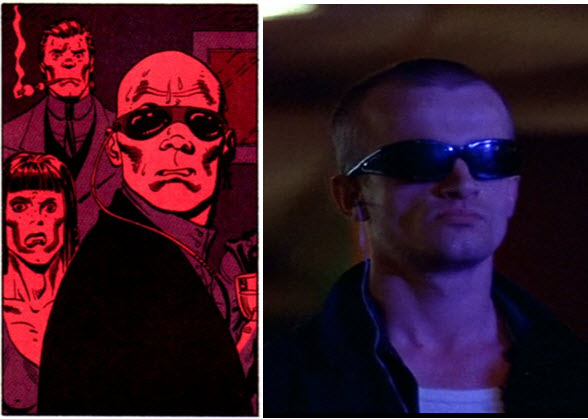
The character with a shaven head and dark glasses is a dead ringer for one of the villains in the popular French movie Diva, which came out in 1981, a few years before Moore and Gibbons were creating Watchmen. The character in the movie (played by Dominique Pinon) had an earphone, which he was constantly pressing to his ear, attached to a cord; the character here has a similar cord attached to his glasses (see page 16, panel 5).

Watchmen chapter 1, page 15, panel 1. A silent panel in which Rorschach walks past a table of people at Happy Harry's, including a bald man in sunglasses, with a cord trailing from them.

So I watched Diva, and I enjoyed it very much. I was particularly looking out for Pinon’s character, who is credited as “Le curé” (which the captions translated as “Priest”, and Roger Ebert glossed as “the treatment.”) Having seen quite a lot of him, I must take issue with the claim that the nameless Watchmen extra (let’s call him Fred) is somehow a “dead ringer” for Le curé. Here they are side by side:

side-by-side

Yes, there are certainly some similarities. They’re both wearing sunglasses, albeit of a noticeably different style. They both have a somewhat broad nose. And they both have a trailing cord near their right ear. However, there are quite a number of key differences as well. Fred is entirely bald, while Le curé has a buzz cut. Pinon has a very distinctive look, with horizontally compressed features and a high forehead that seems to take up as much space as the rest of his face put together. Gibbons could easily have portrayed (or even caricatured) that, but Fred’s features are much more generic.

Importantly, Fred looks frightened in both panels in which he appears. He’s visibly sweating (an excessive amount, really) in the second panel. Le curé never looks nervous. He’s always grim, and most of his lines are just him expressing dislike for things. (“I don’t like parking garages.”, “I don’t like Beethoven.”, “I don’t like elevators.”, etc.) Even when he dies, it happens suddenly, with no time for him to get scared.

Finally, Le curé’s earpiece is a weird and specific character trait. The entire movie, we wonder what he’s listening to, and once he dies we get the payoff, which is that it seems to be jolly accordion music, as might have come from the comical street busker who appears midway through the film. Fred’s not listening to anything, and given that he only appears in two panels of the book, he isn’t enough of a character to be specific. Yes, his croakies are somewhat improbably emphasized in his second panel, but they barely appear at all in his first. It’s quite a slender thread upon which to hang an annotation.

So once again, I think we have a blind alley here. But since I went to the trouble of screening Diva, let’s just suppose for a moment that there indeed is a connection between these two works. Upon what would such a connection hinge?

Well, they do both have a plot trope in common: the villain disguised as a hero. The villain behind the villains in Diva (and the employer of Le curé) is Saporta, the leader of a drug and prostitution ring. The twist is that Saporta also happens to be the chief of police. In fact, when we first see him, he’s directing the Paris police’s investigation into his own gang. Watchmen, of course, has a similar betrayal in that Ozymandias, one of the book’s fraternity of superheroes, is in fact the menace which they all face, and whose murder of a fellow superhero sets the plot in motion.

However, I believe this film’s connection to Ozymandias can be traced even deeper, to a theme that drives them both: questions of permanence. In order to illuminate that further, let’s review part of Diva‘s plot:

The movie’s main character is Jules, a young postman who’s also an opera buff. In particular, he’s a fan of American opera singer Cynthia Hawkins, who is the film’s titular diva. Hawkins has a phenomenal voice, but has idiosyncratically refused ever to release an album, or indeed to be recorded at all. She insists that a concert is a sacred moment between performer and audience, and that this unique moment should not be subject to repetition. Her manager argues with her about this, pointing out that her career cannot continue for many more years on this path. He reminds her that she is thirty-two years old, and even now is exhausted by the effort of giving two concerts a month. “No voice is eternal,” he chides, “except through recordings.” Nevertheless, the diva remains insistent.

Diva-small

Jules, however, has secretly recorded Hawkins’ Paris concert, simply for his own love of the music. His recording expertise is considerable, and the resulting tape is of such high quality that it catches the attention of Taiwanese gangsters, who wish to use it to blackmail Hawkins into signing a record deal with them. The gangsters’ pursuit of Jules provides half of the movie’s narrative propulsion.

The other half arrives when Jules’ life becomes complicated by a different tape. A prostitute named Nadia, who was Saporta’s mistress and knows of his secret criminal identity, has decided to reveal Saporta’s perfidy. She knows she will be killed for this, possibly before she can testify, so she records her testimony onto a cassette. As she heads towards her meeting with the police, she realizes she is being tailed by Le curé and his partner (who is called L’ Antillais.) Eventually, it becomes clear that she will not make it to her rendezvous, so she surreptitiously slips the cassette into the saddlebag of Jules’ moped, which is parked nearby while he makes a delivery. Almost immediately afterward, Le curé kills her with an icepick to the back. When Saporta finally realizes that Jules has the tape that could bring him down, he sends Le curé and L’ Antillais after the harried postman.

So the two MacGuffins that drive the plot are both markers of a struggle with permanence. Hawkins resists having her vocal performances preserved, insisting that her gifts must only be shared within an ephemeral moment. When she is confronted with the fact that a recording has been created without her permission, she is thrown into crisis.

Nadia, on the other hand, relies upon a recording to resolve her crisis. She’s been forced not into permanence but into transience, and hopes that even though she won’t survive her decision to testify, the cassette she created will succeed in destroying Saporta.

Of course, neither story is so simple. Jules (with considerable help) eventually retrieves the concert tape, and plays it for Hawkins. She seems entranced, saying, “But… I’ve never heard myself sing!”, and they dance slowly to the music. There seems to be an implication that she will reconcile with the concept of recording. As for Nadia’s tape, it turns out that she wasn’t as completely reliant on it as it appeared. At one point Saporta is able to get his hands on the cassette, but pulls the truly incriminating evidence out of its case: photos of himself and Nadia together. So in neither situation was the recording an end-all, but in both situations its immutability had a lasting effect on the main characters.

As I touched upon earlier, Ozymandias also wrestles with the nature of permanence. In his soliloquy to the dead men in chapter 11, Veidt frames Alexander’s failure as his inability to build “a unity that would survive him,” and extols the Egyptian pharaohs for “their wisdom, truly immortal.” With his mad alien squid plot, he sees himself as having transcended Alexander’s failure and assumed “the aspect of kingly Rameses, leaving Alexander the adventurer and his trappings to gather dust.” Ironically, he sees his slaughter as a way to preserve humanity. For him, the worst part of nuclear war would be its eradication of the human past, present, and future:

Save for Richard Nixon, whose name adorns a plaque on the moon, no human vestige would remain. Ruins become sand, sand blows away… all our richness and color and beauty would be lost… as if it had never been.

He calls the outcome of his scheme “an end to war… an end to fighting.” Somehow the world’s smartest man fails to see some obvious facts. He seeks to preserve humanity but end fighting? Humanity without fighting would have to be classified as a whole new species, something even the biggest scare couldn’t bring about. Fright may change behavior, but the change won’t be permanent, especially when you’re talking about an entire species over an eternity of time. As Jon must point out to Adrian, “nothing ever ends.”

Thus Ozymandias wrought amazing and monstrous works, but those works will never last forever, though their ruins may retain the power to terrify. Someone wrote a good poem along those lines, but that’s an article for another time.

Next Entry: Ditko Fever
Previous Entry: The Comedians Of Tragedy

The Watchmen Bestiary 10 – The Comedians Of Tragedy

Obligatory spoiler warning in 3… 2… 1…

There are spoilers below for: Watchmen, both the graphic novel and the movie, and The Comedians, both the novel and the movie. End spoiler warning.

In the last installment, we were looking at chapter 1, page 11, panel 3 of Watchmen, in which Dan Dreiberg recounts a rumor about The Comedian’s covert government activities in South America. That in turn led the annotators to cite Alan Moore’s Shadowplay as another angle he’s taken on such activities.

However, what I didn’t mention in the last essay is that they don’t stop there. No, the annotations for that very panel continue with this speculation:

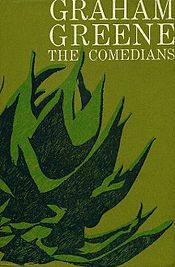
Moore may have named the Comedian in homage to Graham Greene. Greene’s novel The Comedians was about foreign interference in Haiti, and was made into a 1960’s movie with Richard Burton.

comediansSo I read the novel and saw the movie, and I have to say: annotators, this one’s a stretch. I mean, yes, I suppose you could assert that The Comedians is about “foreign interference” in Haiti, but it’s not the kind of interference that Eddie Blake or Shadowplay‘s eagle would recognize. The narrator, a Mr. Brown, is a cynical hotelier, originally hailing from Monaco, and much is made of how his Monaco origin is “almost the same as being a citizen of nowhere.” He’s inherited the hotel from his distant, adventurous, globe-trotting mother, and was hoping to make a go of it in Haiti. Unfortunately, his dream of a tourist paradise was shattered by the ascension of brutal dictator François “Papa Doc” Duvalier. So he’s foreign (to Haiti), but not American, and I wouldn’t really call his presence “interference.”

There are a couple of Americans who do intend to interfere, but they’re far more innocent than sinister. Mr. and Mrs. Smith are evangelistic vegetarians, so much so that Mr. Smith ran for President against Harry Truman on “the vegetarian ticket.” (His status as an American Presidential Candidate gives him a comically disproportionate amount of political clout in the rather ignorant Duvalier regime.) They dream of building a grand “vegetarian center” in Haiti, complete with meals, speakers, movies, literature, and so forth, and they’ve got the financial backing to make it happen. They have no ulterior motive and represent no government. They just believe that meat causes acidity in the body, which leads to bad behavior. In the end, they become disillusioned with the Haitian government and leave the country, taking their money with them. Brown sees them as rather noble in their naivete, but Eddie Blake would find them ridiculous.

Finally, there’s a Brit, a Mr. Jones, who pretends through most of the story to be “Major Jones”, a hero of World War II. He’s got secrets, but they’re secrets of chicanery, not espionage, and the only “interference” he’s up to is a con of Duvalier’s government, a fake arms deal which falls through quite spectacularly. So there’s no CIA, no secret team, no assassins, no coup, no government-toppling agents, and certainly no “knocking over Marxist republics.” Greene has written plenty of books about secret agents, but The Comedians isn’t one of them. In fact, the thrust of the story is an indictment of America’s reluctance to interfere with Haiti — despite the barbarism of Papa Doc and his Tontons Macoutes, he is seen as “a bulwark against communism,” and therefore the United States is no threat to his government.

So as far as parallels to Watchmen, I don’t think there’s much to see here. I’m highly skeptical of the claim that Eddie Blake’s codename is somehow a reference to this story. [Although! In a bit of late-breaking news, I’ve come across an interview in which Moore says, “I believe I took the name from Graham Greene’s book, The Comedians.” So that’s confirmation, but I still think the connection is weak.] That said, the experience of reading the book and then watching the movie brought to mind some Watchmen comparisons from a more unexpected angle.

Greene’s novel was commercially successful and well-regarded by the critics. The movie, on the other hand, was a vehicle for Richard Burton and Elizabeth Taylor to clutch meaningfully at each other against a tragic backdrop. Its supporting actors saw some award nominations, but the film itself has a 27% rating on Rotten Tomatoes. Several critics chided it for its overly faithful approach to Greene’s book, which led it to notch a whopping 156-minute running time. (Greene himself wrote the screenplay.) However, despite its dutiful recreation of many scenes from the book, its ending takes a radical, sudden turn away from the novel’s plot, altering the fate of its main characters and removing an entire layer of story.

Does this sound a little bit familiar? Watchmen the comic is widely regarded as one of the greatest works by one of the greatest comics writers. Its movie, on the other hand, was a bit more of a mixed bag. It has a 64% rating at Rotten Tomatoes — fresh, but just barely — and it is frequently criticized for its overly faithful approach to the graphic novel. It clocks in even longer than The Comedians, at 163 minutes, with the DVD director’s cut running 185 minutes, and an “ultimate cut” that lasts no less than 215 minutes. That’s over three and a half hours, for those of you playing at home. Some of the acting (particularly that of Malin Akerman and Matthew Goode, who look their parts but don’t seem to embody them) falls flat, and the movie sometimes feels like a vehicle for Zack Snyder to stage long fight sequences and film loving close-ups of compound fractures. Also, its ending strips out the whole “space squid” angle from the book, making Ozymandias’ plan center instead on fooling the superpowers into thinking that Dr. Manhattan has turned against humanity.

Watchmenmovie

There are good reasons and not-so-good reasons to depart from source material when making a film adaptation, and both of these films have their share of each. With any work of significant length (novels and graphic novels included), so much detail is present that filmmakers find it impractical to present all of it on screen. Consequently, they employ a number of tricks to compress the work while retaining its essence. Both movies employ some of the big ones:

Technique Comedians film Watchmen film
Removing story/plot sections Excised the first thirty or so pages of the book, in which Brown, Jones, and the Smiths are on a ship together, traveling to Haiti, and sizing each other up. Consequently, it also removes a later section in which Brown and Jones return to the ship. (Also, this isn’t story, but the book is entirely self-aware of its characters’ oddly common names, while the film displays no such awareness.) Most famously, deleted all the Tales Of The Black Freighter stuff, and the attendant recurring newsstand scenes.
Eliminating minor characters Among others, removed Fernandez, a rather mysterious character who shows up initially on the boat, then plays a crucial part in the book’s ending. Pretty much got rid of Captain Metropolis (aside from some very glancing references), which alters the reason why the Crimebusters were brought together. In the movie, it’s Ozymandias as the driving force in that meeting.
Streamlining context The visual elements help make the Tontons Macoutes and the Port-Au-Prince beggars actually more powerful than they are in the book, but the film elides the hotel’s history, and greatly downplays the fact that Brown’s recent absence is from a desperate attempt to dump it. There are so many background elements crammed into the comic, and you can give them all the time and attention you want to. The film can’t hope to match that, though it tries nobly. It also removes scenes like the one with Nixon and his cabinet in the command bunker.
Reducing character development The book has a lot of backstory on Brown’s mother and his education. The movie, not so much. It also leaves out some details about the frauds he’s pulled in his past, which are a key part of his character. Again, give the movie credit for trying, and it does follow the book’s template of going in-depth on one character at a time. However, some significant things are still missing, like Rorschach’s Kitty Genovese story.

All of these changes are fair enough. Compromises must be made, even when you’re making a 163-minute movie. However, some things do get injected that substantially change the artistic statement, often as a result of egos and market forces. For instance, The Comedians movie starred Richard Burton and Elizabeth Taylor in 1967, a time when public interest in their marriage was very high, and when they were in the midst of making a string of movies together. This was their seventh co-starring picture in 5 years. Thus, Brown’s affair with Martha Pineda, wife of the Uruguayan ambassador, gets a magnified role in the movie. Not that it was insignificant in the book, but as Roger Ebert said at the time, “in the movie he (Burton, that is) sees a lot more of her because, baby, when you’re paying Liz Taylor’s salary you really use her in your movie.”

Watchmen, on the other hand, was a comic book superhero movie at a time when comic book superhero movies had become golden tickets for movie studios. Certainly it was a very different sort of superhero story, and its R rating meant that its audience was much more limited than that of, say, X-Men Origins: Wolverine. Nevertheless, it was sure to rake in some cash, and thus Warner Brothers (the eventual owners of the rights after the project spent 2 decades in development hell) approached Zack Snyder, who had proven with 300 that he could adapt a comic book into a hit movie. Snyder brought several kinds of fetishism to the table. His fetishistic adoration of the source material mostly served the movie well. His fetishistic adoration of slow-motion fights, broken bones, and hyper-stylized violence, not so much. I remarked on this when I wrote about the movie for the first time, and in my research for this article I was gratified to find this excellent analysis by Tasha Robinson, who totally gets that point, and explains it much better than I did. Great minds, Tasha, great minds.

Finally, each movie significantly alters the ending of its source material. For Watchmen, this change also serves some of the simplification functions I mentioned above — no space squid means no Max Shea, no Robert Deschaines, no island of artists, no “psychic shockwave” that can somehow kill three million people. I think these changes are actually a win for the movie version — it’s always better when you can achieve the same effect without bringing in extraneous plot and characters. On the other hand, while the book’s carnage is focused solely in New York, the movie gets to blow up Moscow, Tokyo, Paris, etc. This is purely gratuitous. Not to mention, it reintroduces the economy of energy scarcity that Dr. Manhattan had banished, which to my mind would be more likely to cause international tension, not less.

The Comedians, too, achieves some simplification with its changes. In the book, Jones finally lives up to the lies he’s always told about himself, joining a disorganized Haitian rebel militia that is as just as ragtag as it can be. His brand of bullshit actually finds a noble use, inspiring this group in their attacks on Duvalier. Of course, they still fail spectacularly, and Jones dies in the mountains, distracting the enemy while the rest of the squad struggles across the border into the Dominican Republic. Brown, having brought Jones to his rendezvous with the militia, also escapes across the border. There he is confronted with the remains of the militia, and the body of his sole remaining employee, Joseph, who had joined the rebels. He scrounges for work in Santo Domingo, finally becoming an undertaker, apprenticed to Fernandez, that character who got streamlined away in the movie.

burton-taylor

The film still has Brown driving Jones to the rendezvous point, and as in the book, they are discovered by the hostile Tonton named Concasseur. However, in the movie, Concasseur kills Jones before himself being killed by Philipot, head of the rebels. Then, in a complete left turn, Brown decides to assume Jones’ identity and, as Jones, joins and leads the rebels. This gives Burton the chance to look heroic in a way that the novel character never really does, including a rousing speech he gives to the 17 completely uncomprehending French speakers who make up the “militia.”

The movie ends on (who else?) Elizabeth Taylor, getting the news that the rebels attacked a Tonton outpost, resulting in two deaths, Joseph and “one other.” We never know for sure who that other one is, but Taylor, gazing moodily out the airplane window on her flight back to Uruguay, seems to fear the worst. This ending tidies up the plot into a neater, more ironic bundle, and allows the film to continue forgetting Fernandez, but it also keeps the focus relentlessly on the Burton/Taylor romance. In the book, Martha arranges to meet Brown for a last tryst before she leaves for Peru, but she doesn’t show, and Brown is glad — he’s completely emotionally detached from her. The film gives the ending of their romance a noble and tragic note. Thus, if the Watchmen movie was warped to fit its director’s obsessions, so was the Comedians movie warped to stroke the egos of its stars, pulled by the gravity of their fascination with themselves and the public’s fascination with them.

And that’s as connected as Watchmen and The Comedians get. However, there were a few lines in the book that did help shed some light on the meaning of the Comedian’s name, which has been a recurring source of mystery to me. This book is called The Comedians, but it too lacks humor, and its main character is deeply cynical. The explanation for the title comes in a scene at the Uruguayan embassy, in which Brown, a former con man, wonders if Jones is one too. But the words he uses are, “I remember looking at him one night… and wondering, are you and I both comedians?” Then Philipot, a former poet, joins in, saying “Wasn’t I a comedian with my verses smelling of Les Fleurs Du Mal, published on handmade paper at my own expense?” The ambassador cops to being a bad comedian himself, and says, “Perhaps even Papa Doc is a comedian.” To which Philipot replies, “Oh, no. He is real. Horror is always real.” Then Brown and Martha, a page later and away from the party, call themselves comedians for the affair they’re carrying on.

In other words, the comedians of this book are not funnymen. They are comedians as the opposite of tragedians. They adopt personas, acting in their own private commedia dell’arte, to trick and beguile their audiences. They are charlatans. Liars. Only behind the curtain do they acknowledge the difference between the show they perform and the real truth. In a way, Eddie Blake might fit this mold, with his leather mask and his brave face. And yet, if horror is always real, then The Comedian is no comedian, for horror seems to be his stock in trade.

Brown is the jealous type, and he envies the easy rapport that Jones seems to have with others. Jones’ secret? Making people laugh. Brown calls himself a comedian, but he’s far from funny. When his favorite concubine says she liked Jones, Brown has to ask:

“What did you like so much?”
“He made me laugh,” she said. It was a sentence which was to be repeated to me disquietingly in other circumstances. I had learnt in a disorganized life many tricks, but not the trick of laughter.

In that, at least, Brown and Blake have something in common.

Next Entry: No Voice Is Eternal
Previous Entry: The Secret Team

The Watchmen Bestiary 2: There’s a Ship…

[Note: As will be customary for this series, Watchmen spoilers ahoy.]

Continuing my journey through the Annotated Watchmen v2.0, the notes for page 4 of issue 1 addresses the frequently-recurring comic within the series, Tales Of The Black Freighter. Here’s what the annotations have to say:

“The Black Freighter” is the name of a song in Bertolt Brecht and Kurt Weill’s opera The Threepenny Opera. It is sung by a woman who tells of a black freighter that comes into town in order to kill everyone in town but her.

Well, no, not really. As I found out when I rented the 1931 movie version of Threepenny Opera, there is no song called “The Black Freighter.” And by the way, despite its name, The Threepenny Opera is not an opera. It’s a musical.

In any case, there is a song in the show called “Pirate Jenny”, which seems as though it might fit the rest of the description. Funny thing, though: I listened to that song in the movie, and it never mentions a black freighter at all. Now, granted, it was in German, but the captions seemed pretty clear. Jenny sings “Und ein schiff mit acht segeln”, which the captions translate as “And a ship with eight sails.” It’s no black freighter, or at least the lyrics never say so.

A fascinating thing about the Criterion version of the movie is that its second disc provides an entirely different version of the same film. In what was apparently not an uncommon practice at the time, director G.W. Pabst shot two Threepenny Opera films at once. Right alongside the German movie is another one in French, with different actors using the same costumes and sets, as well as a few plot details changed. Knowing this, I thought perhaps that it was the French version which mentions the black freighter, but no. The French lyrics are captioned something like, “There’s a ship at full sail.”

At this point, I felt pretty sure that “Pirate Jenny” was the song to which the annotations refer. But where does this black freighter come from? I didn’t think the annotaters would have just invented the connection from whole cloth. So I dug a bit more, and unearthed Nina Simone’s version of “Pirate Jenny.”

Holy. Crap. My friends, I believe we’ve found our black freighter. Not only that, we’ve found an astonishingly powerful rendition of “Pirate Jenny,” one that sheds a clear light on parts of Watchmen. Upon rereading the book, I found it a little bit odd that “pirates” was the genre that replaced “superheroes” in the comics of the Watchmen world — don’t they really serve entirely different emotional purposes? But the black freighter of Simone’s “Pirate Jenny” is just as visceral a power fantasy as any issue of Wolverine, albeit rather darker. Its pirates exact revenge on the narrator’s oppressors in ways that the Comics Code Authority might never approve, but any bullied kid certainly would.

It also seems no accident that the freighter is black. The racial subtext in Simone’s rendition is clear — so clear really that it’s a stretch to call it “subtext” — but it wasn’t her who injected the black freighter into the lyrics. That was the work of Marc Blitzstein in his 1954 Off-Broadway adaptation of the show — the same translation which launched many a successful cover of “Mack The Knife.” So the freighter’s blackness preceded Simone’s apocalyptic invocation of black revolution — in fact, it was Lotte Lenya who sang the role of Jenny in the 1954 production… just as she had in the 1931 movie. Its blackness, then, is just the blackness of doom, which the narrator anticipates eagerly.

In Watchmen, the freighter also symbolizes not revolution but doom, albeit the doom that the so-called “world’s smartest man” imagines to be a revolution. Ozymandias, like Jenny, envisions his triumph atop piles of corpses, but unlike her, he cloaks his bloodthirsty dream in images of final peace and harmony. He seems genuinely surprised when Jon reminds him of the obvious: there is no “final” peace. Nothing ever ends.

Next Entry: The Old New Comics
Previous Entry: The Black And White Panther

The Watchmen Bestiary 1: The Black And White Panther

[NOTE: This post contains spoilers for the Watchmen graphic novel, and I’m assuming readers are familiar with its plot and characters.]

Remember a few years ago, when I said that I wanted to reread Watchmen, but this time with the Annotated Watchmen alongside? Well, the time has come at last. As expected, it’s producing a much more satisfying reading experience — even just rereading the graphic novel with an eye towards structure and symbolism is deeply rewarding, as opposed to the first time, when I was just reading for the plot. Now the project is spawning a few sub-projects of its own.

I thought it would be fun to pursue the references embedded in the annotations, so as to get a richer understanding of Watchmen‘s various layers of allusion. Here was the first one I saw, in reference to The Comedian’s secret(ish) identity as Edward Blake:

“Edward Blake is obviously a reference to Blake Edwards, the director of the Pink Panther comedies. And, no one’s spotted this, Rorschach’s methods of terrorism are all taken from Pink Panther movies.”

Are they, now? Are they really? Very well, I believe I’ll watch the Pink Panther movies. (That means the Sellers/Edwards Pink Panther movies, mind you. I’m sure Alan Moore wouldn’t want me to have to plow through Alan Arkin, Ted Wass, Roberto Benigni, Steve Martin [who I love, but come on — those are paycheck movies for him], or the truly execrable Trail of The Pink Panther, about which more later.)

Verdict: There’s something valid in the comment, but it’s quite overstated. I’ll buy that Edward Blake refers to Blake Edwards. And there are definitely some parallels between Rorschach’s behavior and one of the movies, The Return Of The Pink Panther. For instance, in the film, retired jewel thief Sir Charles Litton, aka “The Phantom” (played here by Christopher Plummer, taking over the David Niven role from the first movie) investigates a crime for which he’s being framed. In doing so, he pushes around a stoolie, abusing the man’s fingers just as Rorschach does to a low-level underworld type in chapter 1 of Watchmen. Well, not exactly “just as” — Litton’s victim is played for laughs as his hands are squeezed, whereas Rorschach’s target is clearly in agony as his bones snap. But still, the finger torture analogue is there.

There’s an even more blatant connection, though. In Return Of The Pink Panther, Edwards revists the running gag from the previous Inspector Clouseau movie (A Shot In The Dark), in which Clouseau has instructed his manservant Cato to attack him by surprise at any time, so as to keep the Inspector’s battle skills sharp. In Shot, Cato attacks Clouseau in the bedroom and in the bathtub, but in Return he steps up his game by leaping at Clouseau out of the freezer:

Cato leaping at Clouseau out of the freezer in Return Of The Pink Panther

In chapter 3 of Watchmen, Moloch encounters a similarly unpleasant surprise:

Watchmen Chapter 2, page 20, panel 7: Rorschach leaps out of Moloch's fridge, slamming into Moloch.

So yeah, there are definitely parallels, and the “Edward Blake” thing seems like a clear enough reference that the parallels are unlikely to be coincidental. However, that’s about as far as it goes. You don’t see Cato following up on his freezer trick by leaving a “Behind you” note next time around. The Phantom doesn’t shoot anybody in the chest with a grappling hook gun. And Clouseau sure as hell never burns somebody with cooking fat or kills dogs with a cleaver, even if they bite.

Isn’t it odd, too, that while Edward Blake is supposedly The Comedian, it’s Rorschach who gets all the best gags? I mentioned in my last writeup that The Comedian is never funny, but what I didn’t notice is that Rorschach often is. And by “often”, I mean “seldom”, but a lot more often than most of the other characters. It’s Rorschach who actually tells a joke (albeit in his diary — the Pagliacci joke at the end of chapter 2.) He delivers many of his lines with bone-dry irony and sometimes even biting wit. (“Tall order.”) And he provides the biggest laugh in the book — indirectly, admittedly — by dropping Captain Carnage down an elevator shaft, a rather Clouseauesque fate for a villain to meet. His moral simplicity, along with his talent for verbal understatement and physical overstatement, make him the funniest character in Watchmen.

As for the Pink Panther movies themselves, well. One of the worst movies I’ve ever seen, to this day, is The Trail Of The Pink Panther. I didn’t actually walk out of the theater, but considering I was twelve years old when I saw it, I think it was the first movie I’d seen in my life that was bad enough to make me think, “This is a terrible movie,” as it unspooled. It was the first time I can recall thinking critically about a movie while watching it.

Trail is basically the movie equivalent of one of those clip shows that long-running television programs sometimes resort to when deadlines are plentiful but inspiration is not — a loose frame story provides excuses to show lots of highlight reels from previous episodes. Peter Sellers died fully 18 months before production began on the movie, and Edwards strings together a Sellers “performance” by using a bunch of deleted scenes from the fifth and last Pink Panther film, along with the funniest bits from the first four. They haul out the carcasses of Sellers’ major co-stars from the previous films to give talking-head interviews about Clouseau. David Niven was so weak that they actually chose to have his lines dubbed in by Rich Little in post-production.

The movie is so bad that Sellers’ widow in fact sued its producers, claiming that it had diminished her late husband’s reputation. The courts agreed, and awarded her over a million dollars. Still, watching all five Pink Panther movies in a row, I could see why the clip show approach must have appealed to Edwards. Every one of these movies is essentially a bunch of middling-to-great set pieces and jokes dangling from a plot that’s more or less beside the point. I saw these movies first in bits and pieces myself, watching over my parents’ shoulders growing up, and re-watching them now, it’s clear how much they were just vehicles for Peter Sellers to be funny. To watch them in sequence is to witness an actor and director zeroing in on a character’s comedic voice.

In the first, eponymous Pink Panther movie, Sellers isn’t even the lead. He’s a supporting character to David Niven’s roguish jewel thief, but Sellers steals the show so wonderfully as Clouseau that Edwards immediately sought another showcase for the character. He found it with A Shot In The Dark, originally a stage play with no connection to the Pink Panther universe whatsoever. Edwards rewrote the screenplay (along with a pre-Exorcist William Peter Blatty) around the Clouseau character, and Sellers hit another home run.

Lots of people cite Shot as the best Pink Panther movie, but I’d have to disagree. In my opinion, the one where the pieces all came together is the one to which Moore tips his hat: Return of The Pink Panther. That movie reprises the compelling characters and setting from the first movie, layers in the funniest elements of Shot (Cato, Dreyfus), and strips away some of the previous distractions — Clouseau as cuckold, Clouseau starry-eyed in love — to focus on the detective pursuing a case through one spectacular failure after another. They crib some costuming from the intervening Arkin movie, and Sellers perfects his outrageous ultra-French accent, complete with befuddled reactions from other characters. After the formula jells in Return, the subsequent films have the easy rhythm (and sometimes the tiredness) of recurring SNL sketches.

Sellers certainly nails all the physical comedy — I laughed out loud the first time he spun a globe and then tried to lean on it — but I found that my favorite parts were the more subtle verbal interchanges. The conversations where Clouseau, in his certainty, completely bewilders another character while not even realizing he’s doing so, are pure genius to me. And I adore him getting worked up and confronting a suspect with, “I submit, Inspector Ballon, that you arrived home, found Miguel with Maria Gambrelli, and killed him in a rit of fealous jage!” Once the films had fully codified the character, even his wardrobe was funny. Come to think of it, that trenchcoat-and-hat combination looks awfully familiar. Haven’t I seen it in something I read recently…?

Next Entry: There’s A Ship…

Searching For Sugar Man

One of my favorite books as a teen, and a huge influence on me during that time, was a novel called The Armageddon Rag, by the then-little-known George R.R. Martin. The book is about… well, it’s about many things, including loss of innocence, the metaphorical end of the Sixties, the rewards and regrets inherent in revisiting the past, and the enormous power of music. The way it is about those things is that it follows a journalist investigating a murder, one that seems inextricably bound to the music of a fictional Zeppelin-esque defunct band called The Nazgûl, whose lead singer died on the same date as the murder. As the journalist investigates the story, he is startled to discover that the band is getting back together, and somebody who looks and sounds a whole lot like the singer is fronting them…

The documentary Searching For Sugar Man is about many things too, and the way it is about them is that it follows a journalist investigating how a beloved artist died. The artist’s name is Rodriguez. A Detroit singer-songwriter in the Dylan mold, he released a couple of albums in the early 70s — good albums, beloved by producers and critics, but completely ignored by the American audience. He quickly faded into total obscurity. Well, almost total. By some quirk, the albums became wildly popular in South Africa, their protest lyrics credited with awakening an anti-apartheid generation to the possibility and power of questioning authority. One South African describes Rodriguez’s popularity there like so: “If you went into any white, middle-class, liberal home in South Africa and started flipping through the record collection, there are three albums you’d always find: Abbey Road by The Beatles, Bridge Over Troubled Water by Simon & Garfunkel, and Cold Fact by Rodriguez.”

But while there are reams of information available about The Beatles and Simon & Garfunkel, South Africans could learn almost nothing about Rodriguez. They couldn’t even find out how he died, though many seemed to agree it was grisly in some way. Did he immolate himself on stage? Blow his brains out right after the encore? Nobody seems to know, so in the 1990s, South African music journalist Craig Bartholomew-Styrdom starts researching an article whose premise is: “How did Rodriguez die?” He followed the money, made a lot of phone calls, and also made use of this nifty new tool called the Internet. With fan Stephen Segerman, he created a website called “The Great Rodriguez Hunt”, casting far and wide for leads on the mystery.

I don’t want to reveal what he found. It’s best learned watching the film. Quoth Roger Ebert: “Let me just say it is miraculous and inspiring.” For me, it was like a mirror image of The Armageddon Rag: where the story of The Nazgûl is dark and apocalyptic, the story of Rodriguez is redemptive and luminous. Even better, the story of Rodriguez is true. I spent pretty much the entire movie thinking it was a hoax, along the lines of Dave Stewart’s Platinum Weird stunt a few years ago. Nope. It’s not a hoax. It is one hundred percent true, and it shone a light on a couple of things that really moved me.

The first of these is about mystery and music. Not to sound like a village elder, but I am old enough to remember a time when you could hear a song, or an album, and love it, but have almost nothing more than the song or the album. If you heard it on the radio, you might not even know the title or the artist! I once taped a lovely Robert Plant song off the radio, and it took me years to find out the title of the song, and that it was solo Plant rather than Zeppelin.

Even if you owned the music rather than hearing it on the radio, you might have an album cover or some liner notes to peruse, but those could be sparse or willfully obtuse, and in any case they were merely snapshots in time. You could subscribe to Creem or Rolling Stone and get up-to-date news, but only for the artists they chose to showcase. You might be able to find some historical info at the library, for well-established artists, but again, that would be up to the caprice of your library’s collection. Even the albums themselves could be elusive — I remember driving all around Aurora, searching fruitlessly for a copy of Pink Floyd’s The Final Cut.

This atmosphere gave rise to wild rumors and legends. I suppose the poster child for this would be the Paul is dead phenomenon, but these legends lasted well past the Sixties. I remember someone confidently asserting to me that Michael Stipe and Natalie Merchant had a daughter together. It is a truth universally acknowledged that when there is a vacuum of information, human beings will fill that vacuum with speculation, and doubly so for the things we’re passionate about. Thus were many hours spent trading ridiculous stories of our pop idols.

That’s all different now. Don’t get me wrong — the age of rumors wasn’t golden, and I wouldn’t want to go back to it. I absolutely love that we have Google, and Wikipedia, and Shazam, and even horrible ad-splattered lyrics sites. The trade wasn’t something for nothing, though. What we lost was a little bit of that mystique, that sense of the unknowable. Having information at our fingertips about the musical pantheon brings them a lot closer to earth with the rest of us. It’s a mixed blessing.

The other aspect of this film that really spoke to me was about recognition and arrival. The filmmaker speaks to Rodriguez’s daughters, who knew their father as someone who had put his music out into the world, only to see it immediately sink beneath the surface. When they learn that it finally found its home in South Africa, that those songs were deeply loved by an entire nation of people, the revelation is immensely powerful. They see that their father’s spirit, his true self, has been kept alive for all those years. Did the news come too late? Maybe, but I don’t think so. See the movie and judge for yourself.

This part of the movie felt allegorical to me. We each have our core, our essence, and as bravely as we can, we express it to the world. Sometimes the world embraces it, sometimes not so much. But it never goes away. It is there, still waiting to be seen and heard. Sometimes, it gets seen and heard in the most unexpected ways, and when that happens, the resulting illumination is a wonder to behold.

The Avengers

[We interrupt our regularly scheduled IF reviews for this topical superhero discussion. That review of Mentula Macanus is coming soon– er, on its way.]

I’ve been reading a lot of 1960s Marvel comics lately, letter columns and all. I did this once before, with just Spider-Man comics, which was a lot of fun. This time I’m skipping around more from title to title, getting a feel for the way the universe gelled, and how the constant stream of feedback from readers contributed to that process. It’s really given me a sense for what Marvel did differently back in those early days. For a while there, they could almost do no wrong — “what they did differently” was more or less synonymous with “what they did right.”

Know what else I’ve been doing a lot lately? Seeing Joss Whedon’s Avengers movie. Well, okay, just twice, but that counts as “a lot” in my movie-watching book. The movie is everything I wanted it to be. It was even more satisfying the second time around. Like those early Marvels, it makes the right call pretty much every time. Really: just like those early Marvels.

Continued stories

In 1961, when the Marvel Universe as we know it began, comic books were disposable, not collectible. There was no expectation that whoever bought issue #41 would necessarily have bought issue #40 or have any intention to buy issue #42. Consequently, each one was required to be self-contained, with one story, or even multiple stories, that began and ended within its covers. That’s a bit of an oversimplification, but the general expectation was that a comic book contained at least one complete story. Sure, there were motifs that continued from one issue to the next, but they were more or less in the form of an established status quo. Clark Kent always works at the Daily Planet. Lois Lane never gets any closer to figuring out his secret identity. Jimmy Olsen is always just as young and eager and boneheaded as he ever was or ever will be. Stories that deviated from this status quo always made sure to return to it before the issue was over.

Many early Marvels followed this pattern too, though their internal status quo was a fair bit more interesting. However, it quickly became apparent that the stories they wanted to tell were too complex to be contained within a single book. Not only that, they seemed to be attracting older, more sophisticated readers, who might be more reasonably expected to buy a title consistently. So, in many books, “continued stories” became the rule, and whoever read issue #41 might in fact need the previous one or the next one, or several iterations thereof, to get the full tale.

Oh, the complaints that readers sent in about this! The company was accused of greed, insensitivity, poor storytelling, and more. In fact, the hue and cry was so great that at one point Marvel actually abandoned continued stories and tried to keep all issues self-contained. The (predictable) result? Duller, more superficial stories. In fact, it may have almost been a calculated move on their part — by the time they did it, the Marvel Universe had already been established as an enormous tapestry of characters whose lives regularly interwove, collided, and separated again. To write the very kind of stories they had made obsolete may have been their way of saying, “Oh, this? Is this really what you want?” Needless to say, continued stories returned soon afterwards.

In 2012, the majority of movies are self-contained, but there are plenty of franchises in which each sequel moves the characters along a larger arc. However, what we hadn’t seen yet is a movie that ties together multiple franchises in the way that The Avengers does. There are four different lines of movies, each with its own sequel trajectory, that come together in this one. Four sets of stories feed in, and this story will resonate along at least three lines in the future. (I’m not sure if there are going to be any more Hulk movies, though no doubt the success of Avengers makes that outcome more likely. Heck, maybe even Black Widow and Hawkeye will get their own franchises.)

This is an immensely powerful position for a movie to occupy. In the comics, a shared universe gets you several great things:

  • If you’re following multiple lines that come together, you get to feel like an insider when the collisions happen. The more lines you follow, the more satisfying this can be.
  • The coherency of each strand is enhanced by its participation in a greater coherent whole. When Spider-Man bursts into Stark Industries, he may wonder why Iron Man isn’t showing up. Those of us reading Iron Man know that he’s trapped by a villain in another part of the factory, and knowing this lets us feel that both Spidey and Stark are a legitimate part of a larger, grander story.
  • When personalities do come together, especially if they clash, the drama of the encounter is greatly enhanced when each character is fully fleshed out with a detailed background and a story of his own.The Avengers movie inherits each of these advantages, along with the sheer pleasure of seeing a bunch of great actors thrown into an ensemble cast, and an enormous sense of payoff from the most elaborate setup ever.

These people do not get along

As I said, Marvel set up a fictional universe in which its superheroes were constantly running into each other. And when that would happen, inevitably, they would fight at least once. Fans loved seeing the good guys square off against each other, if only from the geeky desire to take the measure of each hero. And so Stan Lee would contrive some sort of misunderstanding or unusual circumstance that would force the heroes into conflict. Letter columns were always full of people eager to know who would win in a fight: Hulk vs. Thor? Thing vs. Iron Man? Spidey vs. Black Widow? Hero vs. hero conflict gave those fans a little satisfaction, though not always as much as they wanted, given that the story often took a left turn before either hero suffered a full defeat.

The Avengers takes this cue and runs with it. And, uh, now it’s probably time for the SPOILERS ASSEMBLE! warning.

The movie gives us so many awesome hero vs. hero matchups:

  • Black Widow vs. Hulk, twice. She dominates him strategically as Banner, he dominates her physically (of course) as Hulk
  • Thor vs. Iron Man vs. Captain America
  • Hawkeye vs. everybody, which was a great way of establishing Hawkeye’s badass credentials. (Casting Jeremy Renner didn’t hurt either.)
  • Stark, Banner, and Cap piercing Fury’s subterfuge, leading to a great 6-way argument and a lovely Whedonesque camera move, inverting the heroes and placing the Staff Of Bad Influence in the foreground
  • Thor vs. Hulk
  • Black Widow vs. Hawkeye

And that’s all before they team up to fight the Big Bad! No wonder this movie had to be 143 minutes long. These matchups do several things for the movie, besides their obvious Big Action Thrill value. I mentioned how turning Hawkeye against everyone, and having him nearly take down the whole shebang, was a great way of establishing him as a powerhouse to be reckoned with, despite his lack of superpowers. Really, that’s true for all the inter-hero fights. In order for us to believe in the enormous victory the Avengers pull off in the movie’s climax, we have to believe in their powers and abilities. Having them establish these against each other is both efficient and effective. This way, we see more heroes in action more of the time, and our belief in one reinforces our belief in the others.

Moreover, the physical conflicts help the movie express the characters’ underlying philosophical conflicts. Superhero stories, at least when they’re done well, are metaphors writ large. So when Thor fights Iron Man, it isn’t just Thor fighting Iron Man — it’s the Mythical/Ancient/Pastoral at war with the Modern/Scientific/Technological, and it’s not accidental that the image of Idealized Patriotism and Selfless Heroism is defeated by neither and brings both together.

Finally, the conflicts move the plot along, which is far from a given in modern action movies. Heroes fighting each other does everything from achieving key turning points (such as when the Widow administers a “cognitive recalibration” to Hawkeye, switching him back to the side of the angels) to subtly filling in explanatory details (such as when Banner finds himself holding the Stick of Psychic Malevolence as he’s getting angry.)

How do you solve a problem like The Hulk?

In fact, this last one helped me understand something about the movie that puzzled me the first time around. I’ve mentioned before that although the Hulk exists in a world of superheroes, he’s not a superhero himself — he’s a monster. Unlike everybody else on the team, he’s not necessarily here to help. This is a hard problem to solve for any story that includes him as a protagonist, and the first time I saw The Avengers, I thought the film hadn’t quite solved it. Why is he all “SMASH BLACK WIDOW!” the first time he appears and then all “SMASH ONLY BAD GUYS AND CATCH IRON MAN AND GENERALLY HELP OUT!” the second time?

Then my friend Tashi suggested this interpretation to me: Banner’s revelation during the climactic battle (“I’m always angry”) indicates that he has figured out that suppressing his anger is the wrong way to go. So instead, he lives with it all the time so that it doesn’t blossom into rage, and tries to atone for his past damage by helping the helpless. (Boy, sounds Whedonishly familiar, doesn’t it?) He believes that he might be able to control “the other guy” now that he’s learned to live with his anger, but he’d rather not take the chance if he doesn’t have to.

Then he gets tangled up with the whole SHIELD thing. He finds himself aboard a massive airship — as he comments when it takes off, that’s a worse place for him to be than even a submarine. Loki’s whole plan is to get the Hulk to wreck everything once he’s aboard the Helicarrier. Well, that and also get Hawkeye to wreck everything from outside the Helicarrier. So, using the remote magic of the Nasty Pointy Spear Of Malefic Intent, he manipulates Banner’s mind (as indicated by the “put down the scepter” scene), weakening his mental control so that when Hawkeye strikes, the Hulk is in rampage mode rather than “I’m at peace with my anger” mode. Then, later, when Banner motors up for the final battle, he’s himself again, and can drive the beast enough to be a hero.

I love this explanation, and I think it’s supported by the film. It’s certainly better than anything Stan Lee figured out in the 60’s. His Hulk was constantly hunted, and his Banner was far from reconciled with his anger. (That is, once it was established that anger is what triggers the change. At first it was actually nightfall that did it, like a werewolf. The anger/stress thing set in pretty early, though.) He tried pills, and he tried locking himself away. He tried staying out of stressful situations. You can imagine how well all that worked out. The comics Hulk was often well-intentioned, but always misunderstood.

There wasn’t a trace in this movie of Thunderbolt Ross-esque anti-Hulkism — on the contrary, the government is looking for Banner to enlist his help, despite knowing he could potentially Hulk out. You don’t get much of that in the early comics, though they repeatedly attempted to cast the monster as a hero. In fact, he was even a charter member of the original Avengers… but he was out of there by the third issue. He’s really not much of a team player.

Homage and better

Having the Hulk be present for the founding of the movie Avengers is just one of the many lovely ways this film pays respect to its source material. Just as in the comics, Loki is intimately involved with the Avengers’ formation. Just as in the comics, the early Hawkeye and Black Widow are a couple, albeit one frequently beset by misfortune. Just as in the comics, the Avengers bicker and argue and crack wise, although the players and personalities are a bit different in the film from how they work in the original stories.

The movie is far from a literal recreation of those early Avengers issues. Instead, like the first Iron Man movie, it faithfully absorbs the spirit of the comics, but compresses, abridges, and enhances to make a coherent story that fits together like an exquisite puzzle. Thank you Joss, for mining the gold from an enormous vein, then shaping and polishing it so beautifully for us. And by the way, that really long sequence shot that went from hero to hero during the third act was JUST AWESOME. Mmmm, I think it’s time to see this movie again.

Syllabus: The Allusive Stevie Nicks

I got both a bachelor’s and a master’s degree in English Literature, and for quite a while there I thought I was going to become an English professor, one of those new media and popular culture types combined with a wide swath of 19th century novels and poetry. Then I watched Laura go through her Ph.D. process, and thought, “There have to be less excruciating paths to travel — maybe I’ll pursue this computer thing.”

I don’t regret for a second my decision to abandon academia, but sometimes my brain starts to spark, and I think of the classes that might have been. Recent such sparkage has been inspired by Stevie Nicks’ new album, which I’ve been listening to many times over (as should surprise few who know me.) I’ve been wanting to write about all these flying thoughts, and suddenly I realized the perfect form. It allows me to gesture grandly towards a bunch of broad themes, without having to apply any actual rigor to discussing them. Hooray! Plus, since it’s imaginary, I don’t have to try to engage with some of the more irritating (to me) aspects of what the field has become, or rather what it was 17 years ago, the last time I read a syllabus. It’s my party, and I don’t have to invite Julia Kristeva if I don’t want to…

In Her Dreams: The Allusive Stevie Nicks

DESCRIPTION
Stevie Nicks’ 2011 album In Your Dreams serves as a capstone to her 35-year career as a singer/songwriter. Its songs both build upon and comment upon many of the themes, poetic modes, and even specific lyrics that emerge from her considerable body of work. Beyond that, they draw from a rich variety of sources — literary, cinematic, musical, autobiographical, and more. As is typical of Nicks, their meanings are layered and their referents not always clear. This class will explore issues of allusion, intertextuality, and influence both external and internal, using the work of Stevie Nicks as a lens and the structure of In Your Dreams as a frame.

COURSE PLAN
We will meet once per week, with each session dedicated to exploring a different aspect of Nicks’ work, as highlighted by a particular song or songs from In Your Dreams. Naturally, these themes enrich each other, so we’ll bring them together more and more as the class goes on, with a couple of sessions at the end devoted to synthesizing what we’ve learned. Class sessions will be focused on discussion, and participation will comprise a key part of the course grade. The other elements of the grade are a final paper and two Chain Links projects, explained below in the Grading section. For each class session, course material will be assigned along with supplementary reading, viewing, or listening of interviews and documentary programs.

GRADING PLAN
Your grade will be based on the following components:

1) Regular attendance and active, engaged participation in class discussions. Students are expected to have paid careful attention to that week’s assigned material, be it words, music, or video, and to arrive in class having already thought through some of its implications and interconnections. I encourage you to do further reading and listening beyond what’s assigned — the more you know, the better you’ll be able to recognize important connections.

2) Two Chain Links projects. As we’ll see in this course, Nicks’ work is deeply engaged with a panoply of sources, works that resonate and harmonize with each other. Together, these works form a web of influence, “the web that is my own” as she sings in “Edge of Seventeen.” The purpose of Chain Links projects is to add to this web. The nature of what you create can be fairly free-form: songs, films, essays, stories, poems, paintings, plays, and computer games are all examples of viable projects. However, while their form is flexible, their content must meet some specific requirements. First, all Chain Links projects must be engaged with Nicks’ work, either directly or on a clear thematic level. Secondly, all Chain Links projects must be approved by me in advance. Meetings will be scheduled during my office hours for these approvals. I also strongly recommend that you bring works in progress to me for coaching sessions, to ensure that you’re on the right track. Because of the flexible nature of these assignments, grading is highly subjective — let’s be sure we’re on the same page.

3) A final research paper, 12-15 pages in length. This is a thesis-driven paper on a topic of your choice, due at the final exam session for the course. As with the Chain Links projects, you are required to discuss your topic with me before turning in your final paper. I expect a research paper to be original in its conception, rigorous in its argument, and polished in its execution. Remember, an “A” paper is one that teaches me something.

Final evaluation components are weighted as follows:
20%: Participation
20%: First Chain Links project
20%: Second Chain Links project
40%: Final paper

ASSIGNED READING
Jane Eyre, Charlotte Bronte
Fleetwood: My Life And Adventures In Fleetwood Mac, Mick Fleetwood
Storms: My Life With Lindsey Buckingham And Fleetwood Mac, Carol Ann Harris
Complete Stories And Poems, Edgar Allan Poe
Wide Sargasso Sea, Jean Rhys
Interview With The Vampire, Anne Rice
The Vampire Lestat, Anne Rice
Reading Packet: Selected articles and interviews

ASSIGNED VIEWING
New Moon, Chris Weitz
The Dance, Fleetwood Mac
Selected interviews and program excerpts

ASSIGNED LISTENING
Fleetwood Mac – “Angel” [Tusk]
Fleetwood Mac – “Destiny Rules” [Say You Will]
Fleetwood Mac – “Dreams” [Rumours]
Fleetwood Mac – “Everybody Finds Out” [Say You Will]
Fleetwood Mac – “Eyes Of The World” [Mirage]
Fleetwood Mac – “Freedom” [Behind The Mask]
Fleetwood Mac – “Gypsy” [Mirage]
Fleetwood Mac – “Illume (9/11)” [Say You Will]
Fleetwood Mac – “I’m So Afraid” [Fleetwood Mac]
Fleetwood Mac – “Not Make Believe” [mp3 provided]
Fleetwood Mac – “Silver Springs” (1997 live version) [The Dance]
Fleetwood Mac – “Sisters Of The Moon” [Tusk]
Fleetwood Mac – “Storms” [Tusk]
Fleetwood Mac – “Sweet Girl” [The Dance]
Fleetwood Mac – “That’s Alright” [Mirage]
Stevie Nicks – In Your Dreams [full album]
Stevie Nicks – “After The Glitter Fades” [Bella Donna]
Stevie Nicks – “Battle Of The Dragon” [Enchanted]
Stevie Nicks – “Bella Donna” [Bella Donna]
Stevie Nicks – “Candlebright” [Trouble In Shangri-La]
Stevie Nicks – “Desert Angel” [Timespace]
Stevie Nicks – “Edge Of Seventeen” [Bella Donna]
Stevie Nicks – “Enchanted” [The Wild Heart]
Stevie Nicks – “Fire Burning” [The Other Side Of The Mirror]
Stevie Nicks – “Ghosts” [The Other Side Of The Mirror]
Stevie Nicks – “Have No Heart” (demo) [mp3 provided]
Stevie Nicks – “I Can’t Wait” [Rock A Little]
Stevie Nicks – “If Anyone Falls…” [The Wild Heart]
Stevie Nicks – “Lady From The Mountain” (demo) [mp3 provided]
Stevie Nicks – “Leather And Lace” [Bella Donna]
Stevie Nicks – “Long Way To Go” [The Other Side Of The Mirror]
Stevie Nicks – “Love Is” [Trouble In Shangri-La]
Stevie Nicks – “No Spoken Word” [Rock A Little]
Stevie Nicks – “Rooms On Fire” [The Other Side Of The Mirror]
Stevie Nicks – “Rose Garden” [Street Angel]
Stevie Nicks – “Secret Love” (demo) [mp3 provided]
Stevie Nicks – “Sleeping Angel” [Enchanted]
Stevie Nicks – “Sorcerer” [Trouble In Shangri-La]
Stevie Nicks – “Stand Back” [The Wild Heart]
Stevie Nicks – “Street Angel” [Street Angel]
Stevie Nicks – “Touched By An Angel” [Sweet November Soundtrack]
Stevie Nicks – “The Wild Heart” [The Wild Heart]
Selected interviews

CALENDAR
Supplemental interviews and articles will be assigned each week along with the scheduled reading, listening, and viewing.

Week 1: Introduction — A brief history of Stevie
In-class listening: “The Chain”, “Dreams”, “Go Your Own Way”

Week 2: “Must secret loves secretly die?” — Clandestine romance and veiled autobiography
Reading due: Fleetwood: My Life And Adventures In Fleetwood Mac
Listening due: “Secret Love”, “Stand Back”, “Everybody Finds Out”, “Secret Love” (demo)

Week 3: “Part of a great romance” — Retrospection and introspection
Reading due: Storms: My Life With Lindsey Buckingham And Fleetwood Mac
Listening due: “For What It’s Worth”, “Rose Garden”, “Love Is”, “Sweet Girl”

Week 4: “Always in and out of your light” — Power struggles and regrets
Reading due: Jane Eyre
Listening due: “In Your Dreams”, “Dreams”, “Silver Springs”, “Bella Donna”
Viewing due: The Dance

Week 5: “In the smoke and the fire” — Fiction and reality
First Chain Links project due
Reading due: Wide Sargasso Sea
Listening due: “Wide Sargasso Sea”, “Fire Burning”, “I Can’t Wait”, “No Spoken Word”

Week 6: “I stare at my city” — Permeable roles and the general maternal
Reading due: Interview With The Vampire
Listening due: “New Orleans”, “Illume (9/11)”, “Ghosts”

Week 7: “The candle burns bright” — Rock and roll vampires
Reading due: The Vampire Lestat
Listening due: “Moonlight (A Vampire’s Dream)”, “Candlebright”, “Lady From The Mountain” (demo), “Sorcerer”
Viewing due: New Moon

Week 8: “The moon never beams without bringing me dreams” — American gothicism
Reading due: Selections from Edgar Allan Poe
Listening due: “Annabel Lee”, “Gypsy”, “Have No Heart” (demo), “Storms”, “Edge Of Seventeen”

Week 9: “I am a soldier’s mother” — Permeable roles and the specific maternal
Listening due: “Soldier’s Angel”, “Desert Angel”, “Eyes Of The World”, “Battle Of The Dragon”, “Freedom”

Week 10: “But you’re so alone” — Isolation within adulation
Second Chain Links project due
Listening due: “Everybody Loves You”, “Sisters Of The Moon”, “Not Make Believe”, “Enchanted”

Week 11: “Like a ghost through the fog” — Closures and hauntings
Listening due: “Ghosts Are Gone”, “Angel”, “Long Way To Go”
Listening to revisit: “Sweet Girl”, “Silver Springs”, “Ghosts”

Week 12: “Love was everywhere, you just had to fall” — Storybook romance
Listening due: “Italian Summer”, “The Wild Heart”, “If Anyone Falls…”, “Destiny Rules”, “Rooms On Fire”

Week 13: “I used to dream that you were an angel” — Resonance of recurring themes
Listening due: “You May Be The One”, “Sleeping Angel”, “Touched By An Angel”, “Street Angel”, “I’m So Afraid”

Week 14: “Deeper than a deep well” — Country music and love songs
Listening due: “Cheaper Than Free”, “Leather And Lace”, “After The Glitter Fades”, “That’s Alright”

M-m-m-my TCONA! [Days 2 and 3]

On day 2 of TCONA, the first trivia event was scheduled at 8:30am, but it was the Quiz Bowl Seeding Test, which I co-wrote. So I wouldn’t be taking it, which was all for the best, since I’d had a late night. I left my sister asleep in our room and toddled on down to the conference room around 9:45, as the test was breaking up.

The next event was “LearnedLeague Live!”, hosted by Shayne Bushfield, or rather his alter ego, Commissioner Thorsten A. Integrity. If you’re not familiar with LearnedLeague, it requires a bit of explanation. The game is played over the Internet, six questions per day in a variety of categories, and with varying levels of challenge. The twist is that each 6-question match places you head-to-head against another player. You must not only answer the questions, but also play defense against the other player by assigning a point value to each question — a zero, two ones, two twos, and a three. The points are how much the other player will score upon answering the question right. Consequently, you’re required to both assess the difficulty of each question and also guess your opponent’s chances at getting it right, depending on his or her skills in the category. And LL provides zillions of stats, so you can make this analysis just as painstaking as you like.

When I first heard about the game, it sounded a bit overwhelming, intimidating, and time-consuming. I stayed away for a while, and then even after I was ready to join, I had to wait to be invited by a trivia buddy. Now that I’m in it, I love it. The questions are excellent, the format is fun, and the whole thing is quite addictive. The live version of it was a lot of fun too. The group was seated at a bunch of tables, 8 people to a table. Each player was assigned a number and given a packet of questions. Then we faced off in a series of 7 four-minute matches — you’d turn the page to reveal the questions, scribble down your answers and assign points to them, then the Commissioner would read off the answers. You’d compare notes with your opponent to learn your scores, and figure out who won the match. Here’s a sample set of questions, along with the point values I gave them and whether I got them right or wrong:

  1. Name the three yellow properties in the standard American version of the board game Monopoly. (1 point, wrong)
  2. This 1942 Aaron Copland ballet tells the story of a young woman, accomplished in all the skills of a cowpoke, who hopes to attract the attentions of the head wrangler on a ranch; commensurate with the pre-feminist tradition of the day, he is unimpressed by her skill but succumbs to her charms when she trades her cowboy duds for a dress and shows a more “womanly” side at the ranch dance. (3 points, wrong)
  3. Among other things, this film is known for G, A, F, (octave lower) F, C. (0, right)
  4. The holiest city of Zoroastrianism, Rhaga, is today known as Rey, a suburb of what western Asian city? (2, wrong)
  5. What is the mode in this number series? 1,2,2,3,3,4,4,4,5,5,5,5,13,17,17 (2, right)
  6. This word can be used generally to apply to any appendix or supplement, but when used as a legal term refers specifically to an amendment to a will. (1, right)

It was a whole lot of fun. I ended up with a record of 3-2-2, which is pretty comparable to how I tend to perform in online LL (I ended my first season 13-11-1, and I’m 18-15-3 overall.) That meant that I didn’t advance to the championship round which was held later that day. My teammate (and tablemate, and the guy who actually invited me to LL) George Doro did, though, and ended up taking the silver medal overall! (Did I mention that TCONA gave out actual medals to event winning individuals and teams? It was pretty cool.)

After lunch was one of my favorite parts of the entire event: a panel featuring Ken Jennings, Bob Harris, and Ed Toutant, talking about Jennings’ match (with Brad Rutter, who bailed on TCONA in the 11th hour) against IBM’s Watson computer. This, as you may know, was an event that I found fascinating, so a live panel on it with Jennings himself was catnip for me. Even better, it turns out that Toutant, in addition to being rich and famous (well, game-show famous), spent his career as an IBM engineer, and served as a consultant to the team that built Watson. He observed the computer’s behavior in its middle stages, and wrote a report that provided his insights as both a software designer and a game-show expert. After that, he played against Watson in its final practice matches before it went in front of the cameras. Toutant’s report is available online at edtoutant.blogspot.com. I particularly enjoyed his entry on gamesmanship, which not only has very insightful tips about Jeopardy! strategy, but finally explains why Watson chose such bizarre dollar amounts for its Daily Double wagers!

The panel explained that there are four strategic elements in Jeopardy:

  1. Daily Double wagering
  2. Picking a square
  3. Buzzing or not
  4. Final Jeopardy wagering

Watson was programmed to take advantage of all these strategic elements to the best of its ability. It picked squares to maximize its chances of finding a Daily Double — these generally occur in the harder clues (the bottom 3 clues of each row), and I was fascinated to discover that according to the unbelievably comprehensive J! Archive, the first column on the board has by far the highest percentage of Daily Doubles found. Watson based its buzz on its confidence level — a delay was intentionally built in on answers where Watson was less confident. And the reason why it wagered such peculiar numbers for Daily Doubles was basically to increase its chances of screwing up an opponent’s mental math. As Toutant wrote, “One of the most challenging parts of Jeopardy! for many players is the need to do quick math in their head under pressure, especially when making a bet. It is always easier for humans to do math that involves only round numbers. Unlike humans, Watson can’t get flustered and forget to carry the one during addition. So Watson should exploit his inherent math superiority by never using a round number on a Daily Double wager… This may give viewers the impression that Watson’s thinking is very precise, but the real motivation is to make the math more difficult for his opponents when they have to make a wager.”

Another great aspect of this panel, and of TCONA in general, was the opportunity to spend some time with Jennings. I wasn’t watching Jeopardy during his run, so he isn’t an icon to me at quite the level he is to some people, but he’s still the closest thing the trivia world to has a rock star. How cool it is, then, that he is down to earth, funny, and personable. In a roomful of trivia nerds, social skills stand out, and Jennings excels in this arena. Interestingly, he didn’t dominate every competition. He held his own, but was beaten in some events. I ended up convinced that his knowledge is very strong, but what made him so hard to beat in Jeopardy was his extraordinary touch on the buzzer — he’s just about peerless in this physical aspect of trivia. Well, unless he’s competing against a computer. Jennings’ own account of TCONA is here.

After the panel were the quiz bowl matches. If you’re not familiar with the quiz bowl format, I explain it here. I think it is still my favorite trivia format. It combines individual challenge (in the toss-ups) with team synergy (in the bonuses), and it encourages that zen trivia flow state that I love. This time, unfortunately, the fates were not with my team. The six-person Anti-Social network added a couple of friends and split into two four-person teams. In addition to that, our team took on an extra person, a Las Vegas native who had shown up solo at TCONA and was seeking a team to join with. He was knowledgeable, but a bit eager, and not terribly accustomed to the format, so there was a bit of a breaking-in period there. Unfortunately, once that period was over, we only had a couple of games left. We played five games in a round-robin format, and ended up doing well in the later ones, but it wasn’t enough to advance us to the finals. On the plus side, I got to spend some time with Dave Gatch, who wasn’t participating in TCONA as a player, but who came out to Vegas to serve as a reader for the quiz bowl portion. (Dave and his mom come to Vegas a lot, so apparently it wasn’t a big sacrifice.)

After flaming out in the quiz bowl, that was pretty much it for my trivia day — the only other events that day were playoffs for which I hadn’t qualified. So that meant that my sister and I got to hit the town! We took the monorail to the Bellagio, saw the fountains, gambled a bit. She took me to a fancy dinner at a wonderful restaurant called Olives, where we had so much delicious food. Once again, we wandered around gambling and hanging out. I taught her a bit more about video poker and she taught me a bit more about slots. At the end, we headed back to Bill’s room for a little more pseudo-Jeopardy, then gambled into the night. It was a great, great time, and a great close to a second day of Vegas and trivia.

Day 3 was playoffs and championships, and I wasn’t much involved. I stuck around to watch the quiz bowl finals, but for some inexplicable reason they chose to repeat a set of questions for the semi-finals — not a lot of fun to sit and watch the same questions asked twice. So I bowed out at some point and went to a final buffet lunch with my sister before she caught her plane for home. I still had one more night at the hotel — I had tickets to see The Beatles’ LOVE (Cirque Du Soleil show) at the Mirage that night. I decided after hearing the album that I had to make a pilgrimage to see the show, so there was no question that if I was in Las Vegas, I’d be going.

And I’m so, so glad I did, but that experience deserves a post all its own. For now, let’s revisit those Learned League questions:

  1. Name the three yellow properties in the standard American version of the board game Monopoly. Atlantic Avenue, Ventnor Avenue, Marvin Gardens
  2. This 1942 Aaron Copland ballet tells the story of a young woman, accomplished in all the skills of a cowpoke, who hopes to attract the attentions of the head wrangler on a ranch; commensurate with the pre-feminist tradition of the day, he is unimpressed by her skill but succumbs to her charms when she trades her cowboy duds for a dress and shows a more “womanly” side at the ranch dance. Rodeo (You’ve probably heard its most famous song, Hoe-Down).
  3. Among other things, this film is known for G, A, F, (octave lower) F, C. Close Encounters Of The Third Kind (This.)
  4. The holiest city of Zoroastrianism, Rhaga, is today known as Rey, a suburb of what western Asian city? Tehran
  5. What is the mode in this number series? 1,2,2,3,3,4,4,4,5,5,5,5,13,17,17 5 (Mode means the number occurring most often.)
  6. This word can be used generally to apply to any appendix or supplement, but when used as a legal term refers specifically to an amendment to a will. Codicil

I ended up tying my opponent in this match, with a score of 5 points each.

Page 2 of 5

Powered by WordPress & Theme by Anders Norén